
5-gallon or roughly 15–25 kg pails
Useful for trials and smaller manufacturing runs. Current commercial programs include frozen pail formats as well as smaller aseptic bag-in-box packs depending on processor.
Bulk strawberry puree is a versatile fruit ingredient used by food and beverage manufacturers for characteristic strawberry aroma, sweet-tart flavor, natural red color and smooth fruit body. Major applications include smoothies, beverages, yogurt preparations, baby food, bakery fillings, frozen desserts, jams, sauces and specialty foods. PFVN supports industrial buyers with conventional and organic programs, technical specifications, packaging, documentation and commercial supply options.
Commercial strawberries are generally cultivars of Fragaria × ananassa. The strawberry is an aggregate accessory fruit: the red fleshy portion carries many small achenes on its exterior rather than containing a single central seed or pit. Commercial puree therefore retains fine fruit solids and may also contain small seed particles depending on the finishing screen.
Ripe strawberries combine delicate aroma, natural sweetness and refreshing acidity. Cultivar, growing region, harvest maturity and crop conditions can influence soluble solids, acidity, aroma intensity, flesh firmness and red color development.
Because strawberry aroma is relatively delicate and the fruit is naturally soft, processing conditions are important. Sorting, pulping, screening, pasteurization, freezing or aseptic filling can all influence the final sensory profile and consistency.
Strawberry puree is available at natural strength and in concentrated formats. Buyers should identify which format is required because solids concentration changes viscosity, freight efficiency, formulation water and fruit loading.
Single-strength puree retains a solids level closer to the original fruit and is widely used in beverages, yogurt preparations, baby food, frozen desserts, sauces and bakery products.
Removing part of the naturally occurring water creates a higher-solids puree. Commercial strawberry puree concentrates are available around 28°Brix and over broader concentrate ranges depending on the processor and application.
Commercial strawberry puree can be produced through different screens. Fine finishes suit smooth beverages and baby foods, while coarser puree can provide more recognizable fruit texture in fillings and preparations.
Products at substantially different °Brix levels should not be compared only on price per kilogram. Fruit-solids concentration and reconstitution requirements affect the true formulation cost.
Commercial specifications vary by cultivar, origin, crop and processing method. Industrial qualification normally considers soluble solids, acid profile, particle size, consistency, color, sensory characteristics and microbiological criteria together.
°Brix indicates soluble-solids concentration and helps manufacturers control fruit loading, sweetness and formulation yield. Current commercial single-strength examples include approximately 5–11°Brix and specifications of at least 6°Brix. Concentrated puree may be supplied around 28°Brix or at other agreed levels.
Strawberry is naturally acidic. Current commercial puree examples commonly specify approximately pH 3.0–4.0, with titratable acidity measured separately as citric acid. Both parameters are useful when flavor balance or processing conditions are important.
Screen size controls the amount and size of retained fruit and seed material. One commercial fine-puree example specifies approximately 0.3–0.6 mm, while other processors offer broader fine-to-coarse particulate options.
Strawberry puree is less dense than banana or some tropical purees but still contributes suspended fruit solids and body. Consistency should be compared using the same measurement method and temperature where it is process-critical.
Puree should have a characteristic ripe-strawberry red appearance. Cultivar, maturity, thermal treatment, oxygen exposure and storage can change brightness and may lead to darker or more brown-red tones.
Qualification should confirm fresh, characteristic strawberry aroma with a balanced sweet-tart profile and freedom from fermented, oxidized, scorched or otherwise objectionable notes.
Specifications may include limits for total plate count, yeast, mold, coliforms and relevant pathogens. Exact limits depend on processing method, package format and intended use.
Confirm whether the product is solely strawberry puree or whether ascorbic acid, acidulants or other permitted processing aids are used. This may affect labeling and formulation decisions.
Strawberry's bright red appearance is associated mainly with anthocyanin pigments, particularly pelargonidin-derived pigments. Their stability is influenced by pH, heat, oxygen, light and the surrounding food matrix.
Thermal processing is often required for microbiological stability, but extended or severe heating can reduce fresh strawberry aroma and contribute to pigment degradation. The effect depends on process temperature, residence time and formulation.
Manufacturers should therefore evaluate the puree after the complete pasteurization, baking, freezing or storage process used in the final product. Incoming color and aroma alone do not necessarily predict finished-product performance.
Strawberry puree is one of the most broadly used berry purees because it combines familiar flavor, natural acidity, red color and adaptable fruit texture. It is widely used across beverages, dairy, baby food, bakery, frozen desserts and fruit preparations.
Strawberry puree provides recognizable berry flavor, color and fruit solids to smoothies, shakes, fruit beverages and blended drink bases. It pairs especially well with banana and other mild fruits.
Application guide → Purees Baby Food ManufacturingFine-screened puree can be incorporated into blended fruit pouches and spoonable products where particle size, acidity, ingredient composition and microbiological criteria meet the manufacturer's requirements.
Application guide → Dairy Fruit Preparations for YogurtA major commercial application for strawberry puree. It can provide fruit flavor and color in stirred yogurt, fruit-on-the-bottom products, cultured dairy desserts and plant-based alternatives.
Application guide → Bakery Bakery Fillings & InclusionsPuree can form the fruit base for pastry fillings, cake layers, fruit pockets and bakery preparations where starch, pectin or other systems control final texture and bake stability.
Application guide → Frozen desserts Frozen Dessert ManufacturingStrawberry puree is widely used in ice cream, frozen yogurt, sorbet, variegates, smoothie bowls and fruit desserts where its color and familiar berry flavor provide strong product identity.
Application guide → Fruit preparations Jams, Preserves & Fruit SpreadsPuree contributes strawberry flavor, acidity and fruit solids to jams, spreads, compotes and blended berry preparations and can be combined with pieces where visible fruit identity is desired.
Application guide →Strawberry's familiar flavor profile allows the puree to move easily between traditional fruit products and newer beverage, snack and dessert applications.
Puree can provide the fruit base for dessert sauces, cheesecake toppings, coulis, syrups and plated-dessert components.
Strawberry puree can contribute fruit flavor and color to confectionery fillings, fruit gels, chocolate centers and layered dessert preparations.
Puree and puree concentrate can be used in fruit snacks, cereal bars, nutrition products and other formulations requiring concentrated strawberry identity and fruit solids.
Aseptic strawberry puree is also used in beer, cider, kombucha and other fermented beverages where processors want authentic fruit character without handling whole berries.
Strawberry puree should not be evaluated only by price per pound. Cultivar, maturity, °Brix, acidity, screen size, color, processing method and package format can materially change performance in the final formulation.
Different growing regions and crop periods may produce differences in flavor, color and analytical values. Buyers with highly visible strawberry products may therefore want to evaluate representative samples before approving a commercial source.
RFQs should identify conventional or organic requirements, natural-strength or concentrate format, desired origin where relevant, annual volume, delivery frequency, destination and packaging preference.
Microbiological requirements depend on processing method, package format and end use. Commercial specifications may address total aerobic count, yeast, mold, coliforms and relevant pathogens together with customer-specific requirements.
Physical quality criteria may include stems, caps, excessive seed material, foreign matter, discoloration, coarse particles and other defects. Smooth beverage and baby-food applications may require a tighter screen specification than bakery or rustic fruit preparations.
Normal crop variation in color, sweetness and acidity should be expected. Defined commercial tolerance ranges provide a practical basis for lot acceptance without assuming every harvest will be sensorially identical.
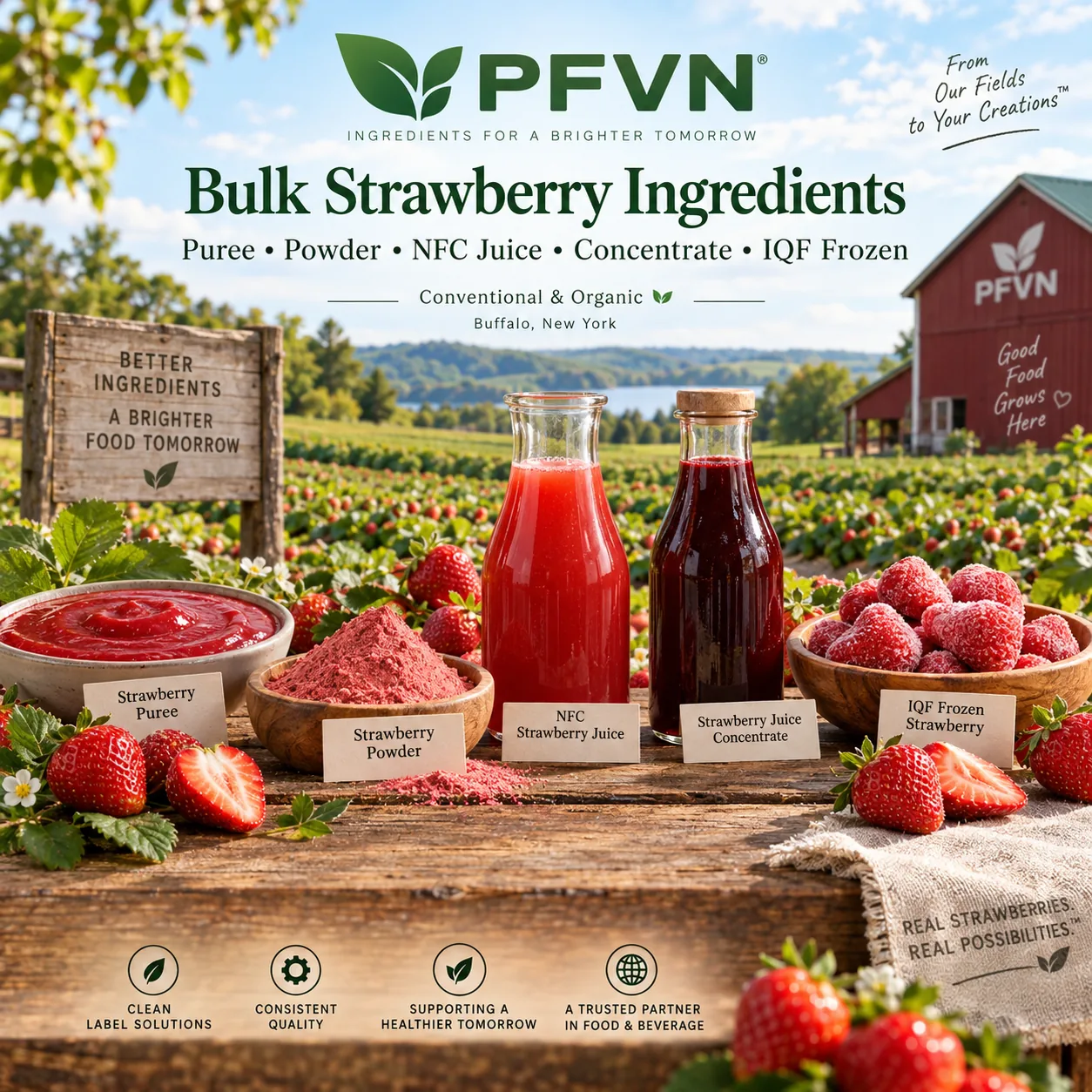
Depending on the application, strawberry may also be sourced as IQF frozen fruit, juice concentrate, NFC juice or powder when a recognizable berry piece, concentrated liquid, single-strength juice or dry-format ingredient better suits the manufacturing process.
Select package size around batch volume, storage conditions, thawing or pumping needs, line rate and inventory turnover. Exact formats depend on whether the product is aseptic, frozen, single-strength or concentrated.
Useful for trials and smaller manufacturing runs. Current commercial programs include frozen pail formats as well as smaller aseptic bag-in-box packs depending on processor.
A common industrial format for aseptic or frozen puree. Current strawberry programs include approximately 425–466 lb drum fills, while exact net weight and liner configuration vary by processor.
Available in selected higher-volume aseptic programs where puree consistency, production volume and customer unloading equipment support bulk tote handling.
Selected strawberry puree programs use aseptic bag-in-box, frozen blocks or lined-carton formats where smaller portions and easier handling are preferred.
Include the application, single-strength or concentrate requirement, target °Brix, pH or acidity, sieve or texture requirement, color expectations, conventional or organic program, quantity, packaging, delivery location and timing.