
Typically around 65° Brix
Current commercial specifications commonly use approximately 65 ±0.5 to 1.0° Brix. This parameter is important for formulation yield, dilution calculations and comparison of delivered fruit solids.
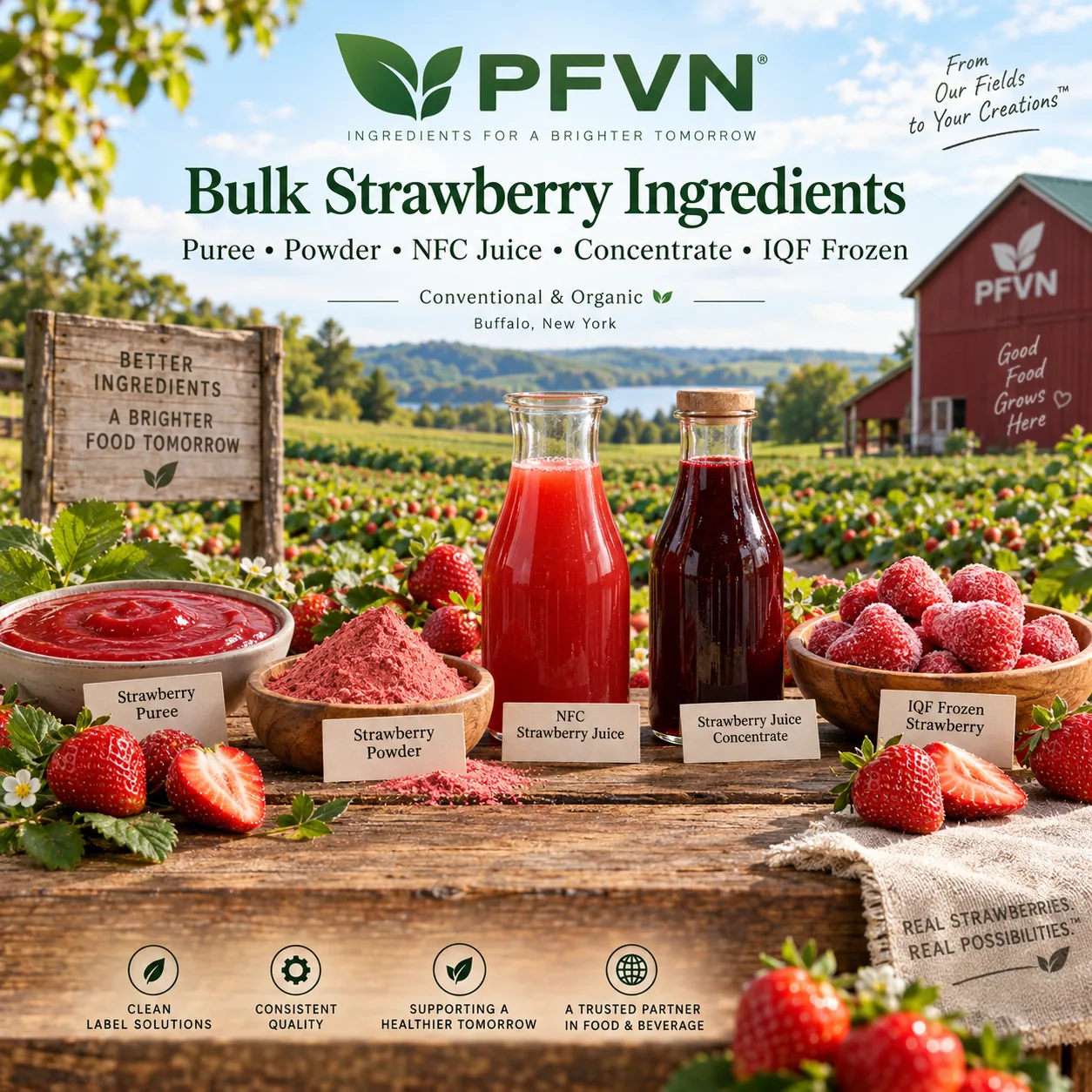
Bulk Strawberry Juice Concentrate is produced from ripe strawberries and provides concentrated berry aroma, natural fruit acidity, soluble solids and characteristic red color. It is used in beverages, dairy preparations, frozen desserts, bakery fillings, confectionery, fruit snacks and industrial fruit systems.
Use these references to prepare an RFQ. Market examples are not PFVN stock specifications, a safety limit or a lot-release guarantee. Organic and conventional grades may differ. Request the current technical data sheet and lot-specific COA.
| Parameter | Reference / request |
|---|---|
| Commercial soluble solids | 50 or 65 °Brix |
| pH | 3.1–3.6 |
| Packaging options to discuss | Aseptic or frozen drums; pails or bag-in-box; totes / IBCs only where the grade, liner and handling system are compatible. Net fill is quote-specific. |
| Order volume & availability | State trial quantity, annual tonnage, delivery schedule and destination. MOQ, origin, pack and lead time are confirmed by quotation. |
| Evidence | Published supplier example [S1]; see reference scope and publication date. Reference register |
Aseptic drums · Frozen drums, totes & IBCs · Organic sourcing · Download specification & dilution guides
The cultivated strawberry (Fragaria × ananassa) belongs to the Rosaceae family. Botanically it is an aggregate accessory fruit: the fleshy red receptacle carries many small achenes on its outer surface rather than containing seeds within a conventional berry.
Ripe strawberries combine natural sweetness, moderate acidity and a highly recognizable fresh-fruit aroma. Cultivar, maturity, growing region and harvest conditions influence sugar-acid balance, aroma intensity and red color.
For juice-concentrate production, strawberries are typically crushed or pressed, screened to remove seeds and coarse solids, clarified where required and concentrated under reduced pressure. Juice concentrate is therefore more fluid and lower in insoluble fruit material than strawberry puree concentrate.
65° Brix is a common commercial strawberry juice concentrate grade. Acidity, pH, color and turbidity vary with crop and processing, so final qualification should use the current supplier specification and an approved production sample.
Current commercial specifications commonly use approximately 65 ±0.5 to 1.0° Brix. This parameter is important for formulation yield, dilution calculations and comparison of delivered fruit solids.
Current supplier examples show pH approximately 2.7–4.0 and titratable acidity around 3.3–8.0% by weight as citric acid, with normal variation by crop year and origin.
Commercial concentrate should show characteristic red color. Variety, maturity, heat exposure, oxygen and storage conditions can influence anthocyanin retention and final color intensity.
Clarified strawberry concentrate is generally produced with low suspended solids and good clarity. Buyers may specify turbidity, sediment or insoluble-solids limits where transparent beverage appearance is important.
Approved material should deliver recognizable strawberry character without fermented, metallic, scorched, caramelized or other objectionable flavors or odors.
Typical specifications establish limits for total plate count, yeast, mold and relevant indicator organisms or pathogens together with customer-specific quality requirements.
Strawberry concentrate is used where manufacturers need recognizable berry flavor, fruit acidity and soluble solids in a more concentrated and pumpable format than single-strength juice.
Used in strawberry beverages, smoothies, juice blends, functional drinks and beverage bases, often combined with apple, banana, raspberry, blueberry, citrus or tropical fruits.
Suitable for yogurt fruit preparations, cultured beverages and plant-based dairy alternatives where strawberry flavor and red-fruit character are required.
Used in ice cream, sorbet, popsicles, frozen yogurt and dessert bases where concentrated strawberry flavor helps maintain fruit intensity after freezing.
Used in bakery fillings, pastry preparations, cake layers, glazes and dessert sauces where concentrated fruit flavor is needed without excessive added water.
Provides strawberry identity, acidity and fruit solids to gummies, fruit jellies, chews, candies and confectionery centers.
Used in fruit compounds, syrups, fruit snacks, bars and multi-fruit preparations where standardized strawberry flavor and soluble solids are required.
Select package size according to annual volume, concentration, storage requirements, production batch size, thawing needs and plant pumping or unloading capabilities.
Often used for development work and smaller manufacturing runs; current commercial 65° Brix strawberry concentrate programs are available in this format.
Common frozen or aseptic bag-in-drum scale for concentrated juices; 52-gallon frozen drum programs are widely used for strawberry concentrate.
Useful for higher-throughput liquid programs where concentrate stability, annual demand and supplier filling capability support tote or IBC handling.
May be available for selected high-volume programs where product stability, sanitary transport and appropriate unloading infrastructure permit.
| Crop and sensory approval | Evaluate red color and seed visibility after processing and compare aroma at the final serving temperature. |
|---|---|
| Regional harvest example | Florida: Dec–Apr. Confirm the growing region and crop year on the quotation. Florida Department of Agriculture seasonal calendar. |
| Format measurements | Compare direct or acid-corrected °Brix, pH and titratable acidity on the same dilution and acid basis. |
| Storage and shelf life | For an aseptic drum or frozen grade, obtain the unopened temperature range and the usable life after opening or thawing. |
| Declarations | Request a current allergen and cross-contact statement, GMO declaration and organic certificate if required for the offered grade and processing site. |
| Pack comparison | If your line takes a 55-US-gallon drum or 275-US-gallon IBC, specify that nominal capacity and ask for compatible liner, discharge fitting and actual net fill. Availability varies by grade. |
| Single-strength labeling reference | 8 °Bx for the corresponding juice under the U.S. percentage-juice rule. Use the offered concentrate specification for purchase limits. 21 CFR 101.30(h)(1). |
| Color acceptance | Agree on sample preparation, dilution and instrument. For L*, a*, b* comparisons, record illuminant, observer and the permitted difference from the approved sample. |
Include your application, target °Brix, acidity, clarity or turbidity, color requirements, certification, estimated quantity, packaging, storage condition, delivery location and timing.
Compare formulation, processing and qualification requirements for these uses. Confirm suitability in your finished product.
| Format | Formulation decision | What to measure |
|---|---|---|
| Bulk Strawberry Juice Concentrate (this page) | Adjustable juice solids | Compare direct or acid-corrected °Brix, pH and titratable acidity on the same dilution and acid basis. |
| Bulk IQF Frozen Strawberry | Pieces or frozen material; specify cut, thawing and handling. | Record cut dimensions, fines and drained yield after a defined thaw cycle. |
| Bulk NFC Strawberry Juice | Natural-strength juice; evaluate freight, flavor and cold-chain needs. | Compare °Brix, titratable acidity, pH and pulp on the undiluted juice. |
| Bulk Strawberry Powder | Dry dosing; specify carrier, moisture, particle size and dispersibility. | Compare moisture, carrier percentage, particle size and bulk density. |
| Bulk Strawberry Puree | Fruit or vegetable body; qualify pulp, viscosity and screen size. | Measure viscosity at a fixed temperature and check screen size and finished texture. |