
Quality & Documentation
Build the RFQ around measurable product requirements and the documentation your quality, regulatory or purchasing team expects to review. Specifications, certificates and program status should be confirmed for the actual ingredient, source and lot being considered.
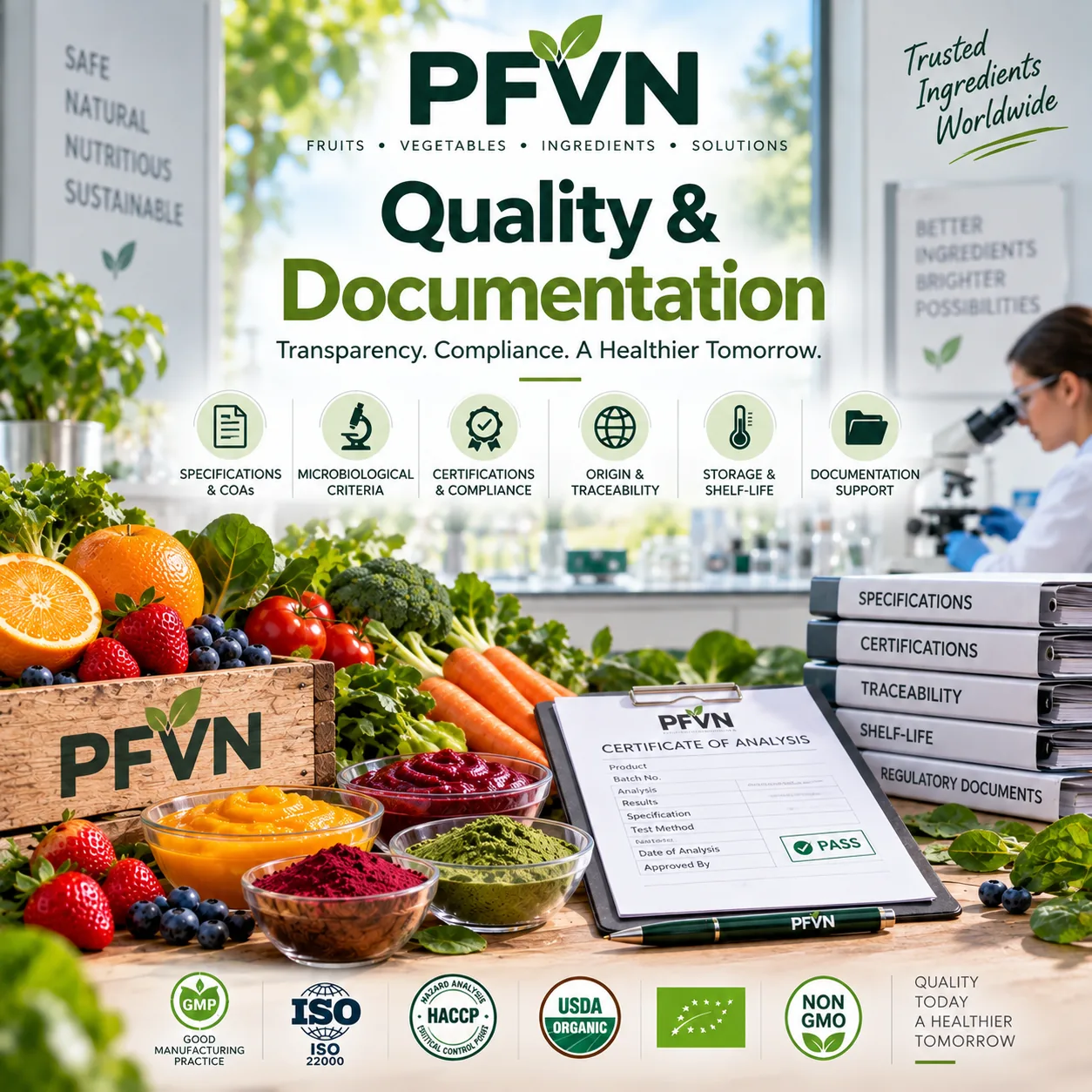
Start with the current specification
Product pages describe available ingredient formats, but the current technical specification or data sheet is the appropriate source for measurable product values. Technical characteristics can differ by raw material, variety, origin, season, processor and production method.
Ask for the parameters that matter to your process. Depending on the ingredient format, these may include °Brix or total solids, pH, titratable acidity, viscosity, moisture, particle size, cut dimensions, color, flavor, pulp level, storage temperature and shelf life.
Physical and chemical parameters
Physical and chemical specifications should reflect how the ingredient will be used in the finished product. For juice concentrates and purees, soluble solids, acidity and pH may be important. For powders, moisture, particle size, mesh and bulk density may be relevant. IQF products may require defined cut size, calibration or defect tolerances.
Specialty ingredients may require other analytical parameters. Citrus oils, for example, may be evaluated using characteristics such as specific gravity, refractive index, optical rotation or volatile profile, while citrus cells may be assessed for pulp content, particle profile and appearance.
Microbiological requirements
Microbiological criteria depend on the ingredient, processing method and intended application. Specifications may include limits or testing requirements for total aerobic count, yeast and mold, coliforms, Enterobacteriaceae or other relevant microorganisms.
Pathogen testing requirements, where applicable, should be defined according to the product category, customer quality system and applicable regulatory expectations. Buyers with specific microbiological limits should include those requirements during qualification.
Certificate of analysis
A certificate of analysis, or COA, generally reports selected analytical results for a particular production lot. The exact parameters shown on a COA depend on the ingredient, processor and quality program.
Buyers should distinguish between the product specification, which defines agreed acceptance limits, and the COA, which reports results for the lot supplied. Where particular tests are mandatory, identify them during the sourcing process rather than assuming they will automatically appear on every COA.
Certification and program status
Organic, Kosher, Non-GMO or other certification and program claims should be confirmed against the specific source and document set for the quoted product. Requirements can differ by ingredient, processor, origin, production facility and intended market.
If certification is a mandatory purchasing requirement, state it clearly in the RFQ. Certification validity, scope and the exact product covered should be reviewed as part of buyer qualification.
Ingredient and allergen documentation
Ingredient declarations and allergen statements help buyers evaluate how an ingredient fits into their own formulation, labeling and allergen-control programs. Where relevant, buyers may also request information regarding processing aids, carriers or other components associated with a particular product.
The applicable documentation should be reviewed for the specific ingredient being purchased rather than inferred from the category name alone.
Country of origin and traceability
Country-of-origin information may be important for purchasing, regulatory, tariff, labeling or customer requirements. Origin can vary by crop, processing source and supply program, so it should be confirmed for the specific material under consideration.
Lot identification and production records are also central to commercial traceability systems. The exact traceability documentation available will depend on the processor and supply program.
Storage conditions and shelf life
Shelf life must be interpreted together with the specified storage conditions. Frozen ingredients, aseptic products, refrigerated products, oils and dry powders can require very different handling environments.
Buyers should confirm recommended storage temperature, package integrity requirements and stated shelf life for the specific product. Once opened, storage and use conditions may differ from those applicable to the unopened commercial package.
Typical buyer document requests
- Current technical data sheet or product specification
- Certificate of analysis for the applicable production lot when available
- Ingredient declaration
- Allergen statement
- Microbiological criteria or test information
- Country-of-origin information
- Organic or other certification documents when applicable
- Storage and handling instructions
- Shelf-life statement
- Packaging and net-weight information
- Lot and traceability information where applicable
Match documentation to the actual product
Documents should correspond to the specific ingredient, processor and supply program being quoted. A technical sheet or certificate from a different origin, manufacturer or product grade should not automatically be treated as representative of another source.
This is particularly important where a formulation depends on narrow analytical limits, specific certification status, origin or customer-defined quality requirements.
Qualification remains with the manufacturer
PFVN can help coordinate the collection of available source documents, but finished-product validation, regulatory review, labeling, supplier approval and suitability assessment remain part of the buyer's own quality and compliance system.
Buyers should verify that the ingredient and documentation meet their own legal, technical, quality and market requirements before commercial use.
Common technical parameters by ingredient format
The appropriate specification depends on the product and manufacturing application. The examples below illustrate parameters buyers commonly evaluate, but actual requirements should be confirmed against the current specification for the product being offered.
Juice Concentrates
Common parameters may include °Brix, pH, titratable acidity, clarity, pulp level, color, flavor and microbiological limits. Concentration and analytical targets vary by fruit, vegetable and processing method.
NFC Juices
Buyers may evaluate natural soluble solids, pH, acidity, pulp content, sensory profile, thermal process and storage conditions. Product values may vary naturally by crop and source.
Purees
Puree specifications can include °Brix, pH, titratable acidity, viscosity, screen or particle size, color, flavor, microbiological criteria and aseptic or frozen processing format.
IQF Frozen Products
Relevant criteria may include variety, whole or cut format, target dimensions, calibration, color, maturity, defects, foreign material tolerances and frozen storage temperature.
Fruit & Vegetable Powders
Powder specifications may include moisture, particle size or mesh, bulk density, color, carrier composition where applicable, solubility or dispersibility and microbiological limits.
Specialty Ingredients
Citrus oils, cells and pastes can require format-specific parameters such as specific gravity, refractive index, optical rotation, volatile profile, pulp characteristics, °Brix, viscosity or moisture.
Define which documents are mandatory.
Quality review is more efficient when mandatory documents and acceptance criteria are identified before samples or commercial orders are arranged. Requirements may differ between product development, first supplier approval and routine commercial purchasing.
- Current product specification
- Required analytical parameters
- Microbiological acceptance criteria
- Certificate or program requirements
- Origin requirements
- Allergen and ingredient declarations
- Storage and shelf-life requirements
- Lot-specific COA requirements
Separate general qualification from shipment documentation.
Supplier qualification often relies on general documents such as product specifications, certification records and declarations. A commercial shipment, however, may also require lot-specific information such as the production code or certificate of analysis.
If your receiving or quality system requires specific documents with every shipment, identify those requirements during commercial discussion so they can be evaluated as part of the supply program.
Use measurable requirements instead of assumptions.
Fruit and vegetable ingredients can vary according to cultivar, origin, harvest conditions, processing method and manufacturer. Product qualification is therefore strongest when based on defined specifications, current documents and lot-specific information where necessary.
If a parameter is critical to your process, include the required range, test method or acceptance limit in your inquiry. This may involve °Brix, acidity, pH, viscosity, particle size, moisture, microbiological limits, certification, origin or another customer-defined requirement.
Send the product, specification requirements and document list.
Include any mandatory certification, microbiological, origin, COA, storage or traceability requirements with your sourcing inquiry.