
Supply Capabilities
A practical supply network for food and beverage manufacturers, ingredient distributors and industrial buyers that need bulk fruit and vegetable ingredients without losing sight of specification, packaging, documentation, commercial volume and delivery requirements.
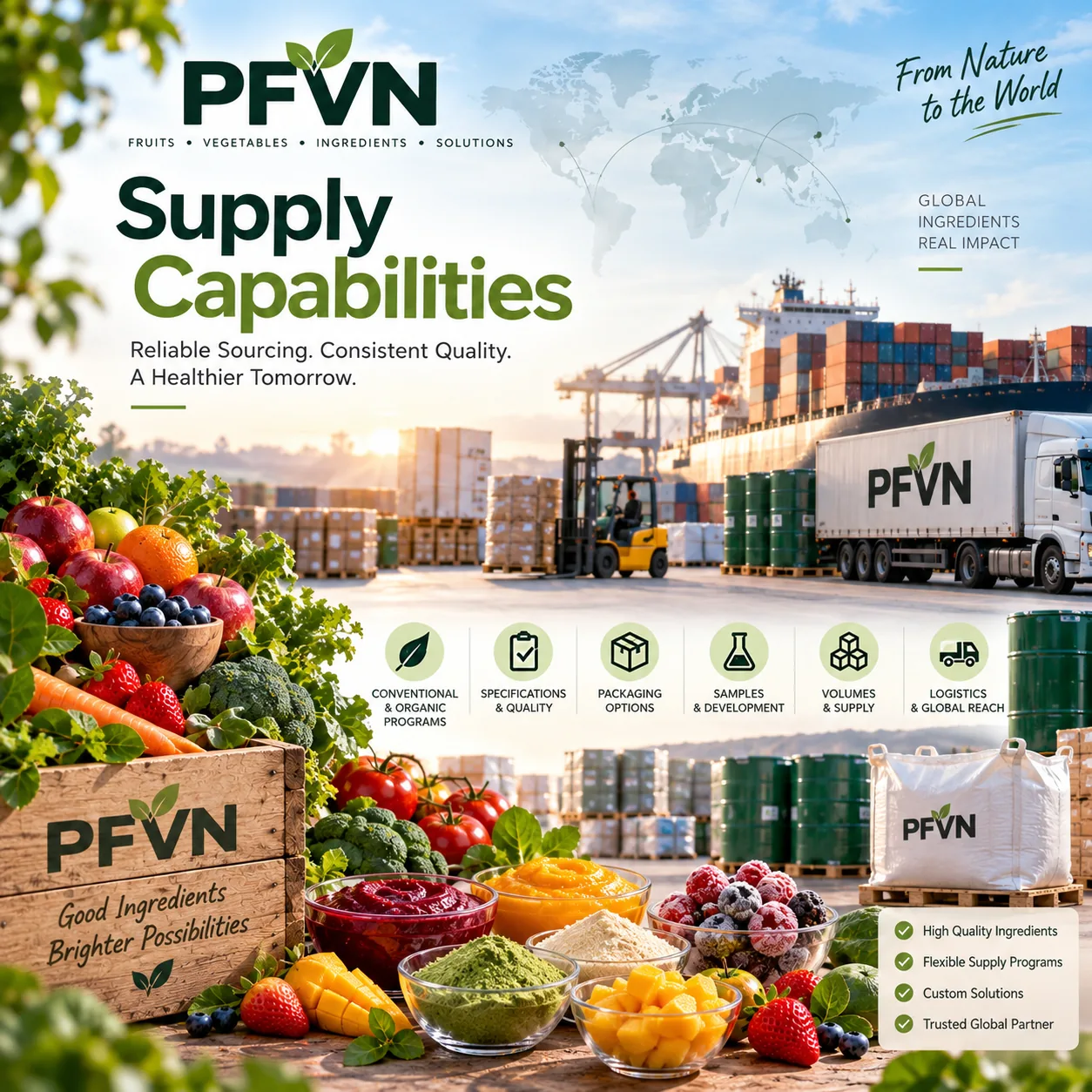
From product request to supply program
PFVN is structured around B2B ingredient inquiries. A useful sourcing request starts with the exact ingredient and format, then adds the technical specification, certification preference, packaging, quantity, destination and required timing. That information helps focus sourcing on programs that are commercially and technically relevant rather than on generic product availability.
PFVN's portfolio includes juice concentrates, NFC juices, fruit and vegetable purees, IQF frozen ingredients, powders and selected specialty formats. The same raw material may be available in more than one format, and each format can behave differently in processing, storage and finished-product formulation.
Specification-led sourcing
Technical requirements can vary substantially by ingredient and application. Depending on the product, buyers may evaluate parameters such as °Brix, pH, titratable acidity, viscosity, moisture content, particle size, color, flavor, microbiological limits and processing method.
Agricultural raw materials naturally vary by variety, crop, origin, maturity, season and processing conditions. For this reason, website information should be used as an initial sourcing reference rather than as a substitute for the current specification applicable to the product being offered.
Conventional and organic programs
Many PFVN product pages reference conventional and organic supply options. Organic status, certification scheme, country of origin and exact program availability are product- and source-dependent and should be confirmed for the specific quotation.
When organic certification or another sourcing requirement is mandatory, include it in the initial inquiry. Buyers may also specify requirements related to origin, ingredient composition, processing method, allergen declarations or other purchasing standards applicable to their program.
Samples, trials and commercial qualification
Product-development teams often need to evaluate an ingredient before moving into commercial purchasing. Sample availability depends on the product, source, package configuration and current inventory. Where samples are available, they can support formulation work, sensory evaluation and preliminary technical qualification.
Commercial approval may require review of the specification, certificate of analysis, ingredient statement, microbiological criteria, origin, certification documents and other information required by the buyer's quality or regulatory team.
Trial quantities through recurring demand
Commercial requirements can range from development samples and initial pallet quantities to container loads and recurring larger-volume programs. Minimum order quantity, sample availability, lead time and contract structure vary by ingredient and source.
Providing expected annual usage can be particularly useful when evaluating recurring programs. It allows the sourcing discussion to consider seasonality, crop timing, production planning, inventory requirements and the appropriate commercial structure for ongoing supply.
Industrial packaging options
Packaging depends on the ingredient format and source. Commercial fruit and vegetable ingredients may be supplied in drums, aseptic bags in drums, pails, cartons, bag-in-box systems, sacks, cases, totes or other industrial configurations.
Exact package dimensions, net weights, liner configuration and pallet quantities should be confirmed for the specific product. Packaging can influence plant handling, warehouse space, thawing requirements, dispensing methods and freight efficiency.
Aseptic, frozen and ambient supply formats
Storage and transportation requirements vary by processing format. Certain concentrates, purees or juices may be available in aseptic packaging, while IQF products and some purees require frozen storage and transportation. Powders and other dry ingredients may typically require dry, controlled warehouse conditions.
Temperature requirements should always follow the product specification and supplier instructions. Buyers should also consider their receiving, storage and production capabilities before selecting a package or supply format.
Quality and documentation support
Ingredient qualification frequently involves more than the commercial quotation. Depending on the product and supply program, documentation may include product specifications, certificates of analysis, microbiological criteria, ingredient statements, allergen information, country-of-origin information and available certification records.
Documentation requirements should be communicated early in the sourcing process, particularly where customer approval, regulatory review or supplier qualification must be completed before purchase.
For additional information, see Quality & Documentation.
North American and international buyer support
PFVN receives and coordinates commercial inquiries from Buffalo, New York. North America is an important market for PFVN, while international inquiries can also be evaluated according to the product, destination, quantity and logistics requirements.
Delivery feasibility depends on factors such as origin, freight mode, temperature control, package configuration, available inventory and final destination. Warehouse delivery, direct shipment and other logistics arrangements should therefore be discussed for the actual supply program rather than assumed at category level.
Freight and delivery planning
Logistics requirements differ significantly between ambient, refrigerated and frozen ingredients. Freight planning may involve dry van, refrigerated truck, less-than-truckload, full truckload, intermodal or ocean freight depending on the product, shipment size and route.
Accurate destination information is important when preparing a commercial inquiry. Include the delivery city, state or province, postal code and country where possible so that packaging and freight considerations can be evaluated in the correct context.
More detail is available on the Packaging & Logistics page.
Seasonality and supply planning
Fruit and vegetable ingredients originate from agricultural supply chains, so harvest timing, crop conditions and regional production cycles can affect availability. Processed formats can extend availability beyond the harvest period, but larger recurring requirements may still benefit from advance planning.
Buyers with predictable annual demand should provide anticipated volumes and purchasing schedules where possible. This helps identify whether a spot-purchase approach or a more structured supply program may be more appropriate.
What to include in your sourcing request
A well-defined inquiry allows product, technical and logistics requirements to be reviewed together. When available, include the following information:
- Ingredient name and required product format
- Intended food, beverage or industrial application
- Target specification or critical technical parameters
- Conventional, organic or other certification requirements
- Preferred packaging format and package size
- Trial quantity, order quantity or estimated annual volume
- Delivery city, state or province, postal code and country
- Required delivery timing or purchasing schedule
- Any mandatory quality, regulatory or documentation requirements
Key factors that shape an ingredient supply program
Commercial ingredient sourcing combines technical suitability with packaging, availability, documentation and logistics. Each of these elements can affect whether a product is appropriate for a particular manufacturing program.
Product Specification
Define the parameters that matter to your formulation, such as °Brix, acidity, pH, viscosity, moisture, particle size or microbiological limits where applicable.
Origin & Certification
If country of origin, organic status or another certification is mandatory, identify the requirement before qualification because availability can vary by source.
Packaging
Confirm package type, net weight and handling requirements to ensure the product can be received, stored and efficiently used within your facility.
Commercial Volume
Sample, trial, pallet, truckload and recurring requirements can involve different minimum quantities, lead times and commercial structures.
Storage & Temperature
Aseptic, frozen and dry products require different storage and transportation conditions. Confirm the applicable requirements before shipment.
Destination & Timing
Delivery location and requested timing influence freight planning, inventory decisions and the overall feasibility of the supply program.
Multiple ingredient formats for different manufacturing needs
PFVN's product portfolio spans multiple processed fruit and vegetable formats. Selecting the right format depends on the formulation, desired sensory profile, processing method, storage capability and commercial requirements.
- Juice concentrates for beverages, fermentation and food formulations
- NFC juices for single-strength juice applications
- Fruit and vegetable purees for body, texture and solids
- IQF frozen ingredients for whole pieces and particulates
- Powders for dry systems, mixes and shelf-stable formulations
- Specialty formats including selected citrus and fruit ingredients
Confirm the current specification before commercial approval
A website category or product name does not define every technical property of the ingredient. Specifications can vary by origin, manufacturer, crop, variety and processing method.
Purchasing, R&D and quality teams should evaluate the current technical documentation for the offered product and identify any mandatory acceptance criteria before qualification.
Send the product, specification, quantity, packaging and destination.
Include certification, technical parameters, delivery timing and annual volume where relevant so the request can be evaluated in the correct commercial context.