

Powder
Acai
Powders & Specialty Ingredients
View product →Fruit and vegetable powders for dry mixes, beverages, bakery, seasoning, nutrition and formulated foods. Powder format can simplify dry blending, storage and dosing while providing fruit or vegetable solids, flavor, color and other formulation characteristics in a low-moisture ingredient.
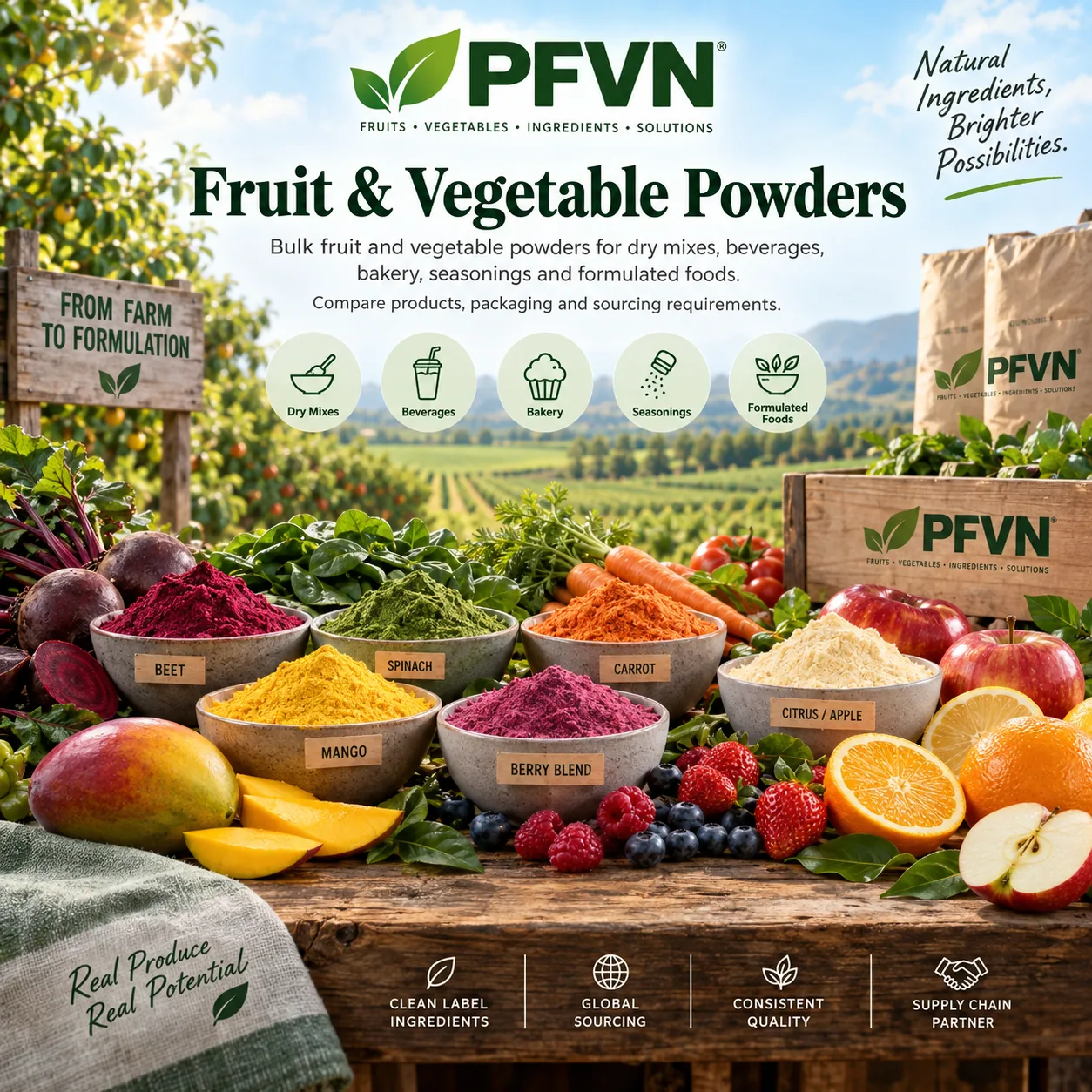
Fruit and vegetable powders can be used where manufacturers need dry handling, concentrated solids, flavor, color or ingredient identity without introducing the water associated with juice or puree. The exact functional profile depends on the raw material, drying method, carrier system where applicable, particle size and final moisture level.
Powders are not one standardized format. Some products may be produced from juice, puree, whole fruit or vegetable material, while others may include processing aids or carriers to support drying and flow. Buyers should review the current ingredient statement and technical specification for the exact product being considered.
Powder performance can vary considerably by ingredient and manufacturing process. Exact limits should be confirmed on the current product specification or certificate of analysis rather than assumed from the ingredient name alone.
Moisture content is an important stability and handling parameter for dry ingredients. Excess moisture can influence caking, flowability and shelf life, while acceptable limits vary by powder type and processing method.
Particle size affects blending, dusting, mouthfeel, dispersion and appearance. A buyer may specify a mesh range or particle-size distribution where uniformity is important to the finished application.
Bulk density influences package fill, dosing, warehouse space and blending behavior. Apparent or tapped density may be relevant where volumetric handling or automated feeding systems are used.
Some powders are intended to dissolve or disperse readily in liquids, while others naturally contain insoluble fruit or vegetable solids. The appropriate requirement depends on the application and processing method.
Color, aroma and characteristic flavor can vary by raw material, origin, drying process and storage. Heat-sensitive fruit notes or natural pigments may respond differently to different drying technologies.
Specifications may include limits or testing requirements for total aerobic count, yeast, mold, coliforms and other relevant microorganisms. Required criteria depend on the product and customer program.
Powders & Specialty Ingredients
View product →
Powders & Specialty Ingredients
View product →
Powders & Specialty Ingredients
View product →
Powders & Specialty Ingredients
View product →
Powders & Specialty Ingredients
View product →
Powders & Specialty Ingredients
View product →
Powders & Specialty Ingredients
View product →
Powders & Specialty Ingredients
View product →
Powders & Specialty Ingredients
View product →
Powders & Specialty Ingredients
View product →
Powders & Specialty Ingredients
View product →
Powders & Specialty Ingredients
View product →
Powders & Specialty Ingredients
View product →
Powders & Specialty Ingredients
View product →
Powders & Specialty Ingredients
View product →
Powders & Specialty Ingredients
View product →
Powders & Specialty Ingredients
View product →
Powders & Specialty Ingredients
View product →
Powders & Specialty Ingredients
View product →
Powders & Specialty Ingredients
View product →
Powders & Specialty Ingredients
View product →
Powders & Specialty Ingredients
View product →
Powders & Specialty Ingredients
View product →
Powders & Specialty Ingredients
View product →
Powders & Specialty Ingredients
View product →
Powders & Specialty Ingredients
View product →
Powders & Specialty Ingredients
View product →
Powders & Specialty Ingredients
View product →
Powders & Specialty Ingredients
View product →
Powders & Specialty Ingredients
View product →
Powders & Specialty Ingredients
View product →
Powders & Specialty Ingredients
View product →
Powders & Specialty Ingredients
View product →
Powders & Specialty Ingredients
View product →
Powders & Specialty Ingredients
View product →
Powders & Specialty Ingredients
View product →
Powders & Specialty Ingredients
View product →
Powders & Specialty Ingredients
View product →
Powders & Specialty Ingredients
View product →
Powders & Specialty Ingredients
View product →
Powders & Specialty Ingredients
View product →
Powders & Specialty Ingredients
View product →
Powders & Specialty Ingredients
View product →
Powders & Specialty Ingredients
View product →
Powders & Specialty Ingredients
View product →
Powders & Specialty Ingredients
View product →
Powders & Specialty Ingredients
View product →
Powders & Specialty Ingredients
View product →
Powders & Specialty Ingredients
View product →
Powders & Specialty Ingredients
View product →
Powders & Specialty Ingredients
View product →
Powders & Specialty Ingredients
View product →
Powders & Specialty Ingredients
View product →
Powders & Specialty Ingredients
View product →
Powders & Specialty Ingredients
View product →
Powders & Specialty Ingredients
View product →
Powders & Specialty Ingredients
View product →
Powders & Specialty Ingredients
View product →The same fruit or vegetable can behave differently as a powder depending on how it was processed and what portion of the raw material was used. Buyers should match the powder format to the intended manufacturing process rather than selecting only by ingredient name.
Spray drying is commonly used for liquid feeds such as juices or purees. Depending on the raw material, a carrier may be used to support drying, powder recovery or flow. Confirm carrier type and percentage where formulation or labeling requirements make this important.
Freeze-dried materials may be selected where retention of certain sensory or physical characteristics is important. Particle structure, moisture, cost and handling can differ from other powder formats.
Some powders are produced from dried whole fruit or vegetable material and may contain naturally occurring fiber and insoluble solids. These can behave differently from juice-derived powders in beverages and fine dry blends.
Maltodextrin or other permitted carriers may be present in selected powders depending on the drying process and product design. Buyers should request the current ingredient statement if a carrier-free or specific composition is required.
Particle size, moisture, sugar content and storage humidity can influence flowability and caking. Hygroscopic powders should be kept properly sealed and protected from moisture during storage and production handling.
Powders can be incorporated into premixes, seasonings, bakery blends and beverage systems. Mixing sequence and particle-size compatibility can affect blend uniformity and segregation during transport or filling.
Powders are used across dry beverage systems, bakery mixes, seasoning blends, soups, sauces, confectionery, teas and other formulated foods. Our application library connects procurement and product-development questions with relevant PFVN powder formats.
A complete RFQ helps distinguish between powders that may share the same fruit or vegetable name but differ in composition and manufacturing behavior.
Fruit and vegetable powders may be packed in lined sacks, cartons, drums or other industrial dry-ingredient formats. The appropriate package depends on the powder, source and commercial quantity.
Many powders are sensitive to humidity and may become less free-flowing when exposed to moisture. Follow the current storage and shelf-life instructions for the specific product, keep opened material appropriately closed, and confirm package configuration before purchase.
Powders can differ by raw-material basis, carrier system, drying technology, particle size, moisture and concentration of fruit or vegetable solids. These differences can affect labeling, flavor intensity, color, solubility, flow and usage level.
For commercial qualification, review the current product specification and ingredient statement for the actual powder being offered rather than relying on a generic category description.
Include any required moisture, mesh, carrier, solubility, microbiological, certification, packaging or storage requirements so the inquiry can be matched to the appropriate supply program.
Share particle size, carrier restrictions, moisture/dispersibility needs, packaging and annual volume.