
About 10–15 kg
Barrier bags in cartons are commonly used where protection from moisture, oxygen and light is important.
Bulk Apple Powder for industrial buyers seeking a dry-format fruit ingredient for beverage powders, bakery systems, dry mixes, nutritional products, seasonings and specialty formulations. PFVN helps industrial buyers match ingredient specifications, documentation, packaging and supply requirements to the needs of their manufacturing programs.
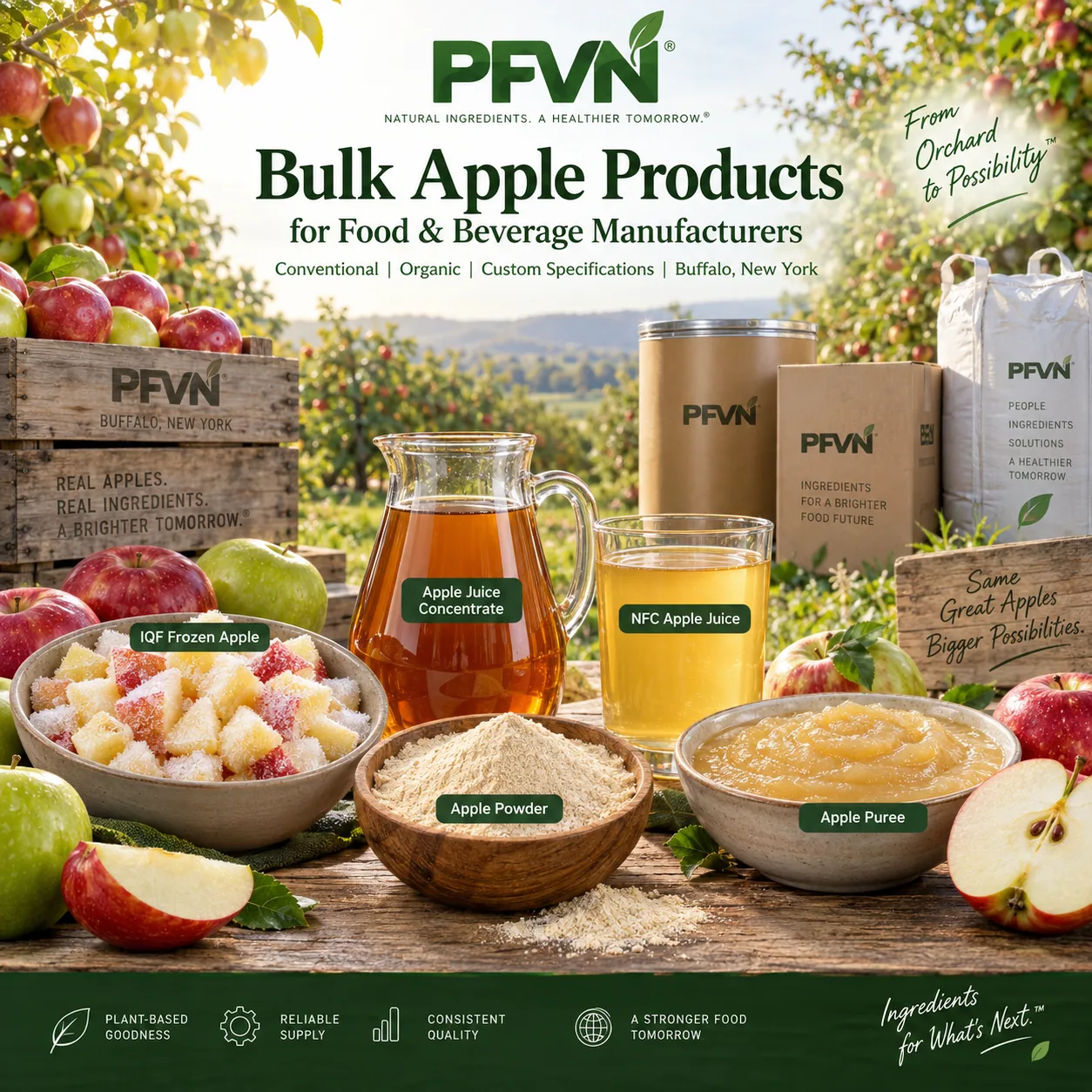
PFVN supplies apple in powder formats for qualified food, beverage and ingredient programs. Apple powder offers a low-moisture alternative to juice, puree or frozen fruit and can contribute apple flavor, fruit solids and color while remaining compatible with dry blending and powdered manufacturing systems.
Commercial apple powders may be produced through different drying and processing methods, including spray drying and other dehydration technologies. Depending on the process, the powder may contain a carrier or processing aid to improve drying efficiency, powder flow or dispersibility. Buyers requiring carrier-free or specific-label formulations should state those requirements clearly during qualification.
Important technical parameters may include particle-size distribution, moisture, water activity, bulk density, color, flavor profile, solubility or dispersibility, carrier composition, microbiological limits and packaging barrier performance.
Exact values depend on the processing method and source, but these characteristics are commonly reviewed when selecting apple powder for industrial applications.
Low moisture helps support shelf stability and powder flow. Water activity can also be important for storage stability and caking behavior, particularly in hygroscopic fruit powders.
Particle-size distribution affects blending, dusting, dissolution, mouthfeel and processing behavior. Buyers should define a mesh or particle-size requirement where it is important to the application.
Bulk density influences dosing, packaging volume and transport efficiency. Flowability can be affected by particle size, moisture, carrier system and storage conditions.
Some applications require rapid dispersion in water or other liquids, while others use the powder in dry systems. Required reconstitution behavior should be matched to the manufacturing process.
The manufacturing method can influence flavor intensity, color, particle morphology, solubility and ingredient declaration. Spray-dried fruit powders, for example, may use a carrier such as maltodextrin or another permitted material to support drying and reduce stickiness.
Other drying technologies may produce powders with different sensory, texture or rehydration characteristics. Buyers should therefore confirm whether the offered material is spray-dried, drum-dried, freeze-dried or manufactured through another process when that distinction affects the finished product.
Carrier percentage and carrier identity can also be important for nutritional calculations, label declarations, flavor intensity and formulation economics. If a particular carrier is unacceptable, this should be specified before sampling or commercial approval.
Fruit powders can be hygroscopic and may absorb moisture from the surrounding environment. Packaging and warehouse conditions should therefore be matched to the powder's moisture sensitivity and shelf-life requirements.
Industrial powder programs commonly use lined bags, cartons, drums or other moisture-resistant bulk packaging. Exact pack size and liner structure should be confirmed in the commercial specification.
Powders should generally be protected from moisture, excessive heat and direct light according to the supplier's specification. Poor storage can contribute to caking, color change or flavor deterioration.
Opened containers should be protected from ambient moisture and contamination. Post-opening handling and recommended use period should follow the supplier's technical guidance.
Receiving teams should verify lot identification, packaging integrity and applicable shelf-life information before releasing material to production.
Apple powder can be used where manufacturers need fruit character in a dry, easy-to-dose format. Final suitability depends on powder type, carrier system, particle size and the supplied specification.
Microbiological specifications vary according to process, application and supplier. Depending on the program, buyers may review total plate count, yeast and mold, coliforms or other indicator organisms together with requirements concerning specified pathogens.
Fruit powders used in sensitive nutritional, beverage or dry-blend applications may also require specific limits for moisture, foreign material, heavy metals, pesticide residues or other parameters according to the buyer's quality program.
Analytical methods and acceptance limits should be aligned before commercial approval, especially where the finished product has strict regulatory or customer-specific requirements.
Depending on the application, apple may also be supplied as puree, juice concentrate, NFC juice or IQF frozen pieces when a liquid, higher-moisture or piece-form ingredient is better suited to the manufacturing process.
Moisture-protective formats commonly used for fruit and vegetable powders for Bulk Apple Powder. Select package size around batch volume, storage, thawing or pumping needs, line rate and unloading equipment.
Barrier bags in cartons are commonly used where protection from moisture, oxygen and light is important.
A common industrial dry-ingredient format for free-flowing powders where appropriate.
Provides rigid protection and strong moisture control for powders during storage and transport.
Useful for evaluation, pilot production and high-value powders; availability depends on the supplier program.
Include the powder type, drying process if relevant, carrier requirements, particle size, moisture target, quantity, packaging, delivery location and timing. We’ll use those details to route your inquiry efficiently.