
5-gallon or roughly 15–25 kg pails
Useful for trials and smaller manufacturing runs. Depending on the supplier, these may be offered in frozen or other suitable commercial configurations.
Bulk apple puree is a versatile fruit ingredient produced from the edible portion of apples and used where manufacturers need natural apple flavor, fruit solids, body, texture and a mild fruit base. PFVN supports industrial food and beverage buyers with conventional and, where available, organic apple puree programs, technical specifications, documentation, samples, packaging and commercial sourcing information.
Commercial apple puree is generally produced from Malus domestica fruit selected and processed to create a smooth or controlled-texture ingredient. Unlike clarified apple juice, puree retains a larger proportion of the natural pulp and insoluble fruit solids, giving it greater body, opacity and texture.
Apple cultivar, maturity, growing region and crop conditions can influence natural sugars, acidity, aroma, color, pectin behavior and processing yield. Sweeter cultivars can contribute a softer flavor profile, while more acidic varieties can provide greater tartness. Commercial processors may also use variety blends to achieve more consistent flavor, solids and processing performance from crop to crop.
Malic acid is the principal organic acid associated with apple's characteristic tartness. Apples also naturally contain pectic substances and structural fiber, which contribute to the consistency and rheological behavior of puree. Cultivar and processing conditions can therefore influence viscosity and particle behavior even when products have similar soluble-solids levels.
Apple puree can serve as the main fruit component of a formulation or as a supporting fruit base in blends where manufacturers need mild flavor, natural sweetness, fruit solids and smooth body without overwhelming more aromatic fruits.
Apple's relatively neutral-to-mild fruit character makes the puree useful both as a recognizable apple ingredient and as a supporting base for berry, stone-fruit and multi-fruit formulations.
Retained fruit solids contribute body and mouthfeel. Natural pectic material and particle structure can influence viscosity, suspension and finished-product consistency.
Puree contributes both soluble and insoluble apple components, making it useful where manufacturers want more fruit substance and texture than would normally be obtained from clarified apple juice.
Industrial apple puree may be refined to different particle profiles. The required screen or sieve should be selected according to beverage smoothness, spoonable texture, filling performance or other manufacturing requirements.
Apple puree specifications vary by supplier, origin and processing method. The following parameters are commonly reviewed during formulation trials, quality approval and commercial sourcing.
°Brix is used to monitor soluble-solids concentration and is important for sweetness, fruit-solids contribution, formulation yield and batch consistency. As a procurement reference, USDA specifications list a minimum 11.5°Brix for single-strength aseptic apple puree; the actual commercial specification being offered should always be confirmed.
Apple acidity is primarily associated with malic acid. pH and titratable acidity affect flavor balance and can influence processing conditions and interaction with other ingredients. USDA's aseptic fruit-puree reference lists apple at pH 3.2–4.2, but individual supplier specifications may define narrower or different acceptance ranges.
Consistency influences pumping, mixing, filling and finished-product mouthfeel. Results should only be compared when the analytical method, temperature, instrument and measurement conditions are equivalent.
Screen or sieve size controls the degree of particle reduction and retained fruit texture. Smooth beverages and baby foods may require a finer finish, while fillings and spoonable foods may tolerate or benefit from greater body.
Cut and processed apple tissue is susceptible to enzymatic and oxidative browning. Raw material, heat treatment, oxygen exposure, processing time and permitted antioxidant treatments can therefore affect puree color.
Commercial qualification may include characteristic apple flavor, aroma, sweetness-acidity balance and absence of fermented, oxidized, scorched or other objectionable sensory notes.
Specifications may include limits for aerobic plate count, yeast and mold, coliforms and relevant pathogens. Acceptance criteria should reflect the product, process, package format and intended manufacturing application.
Confirm whether the product is 100% apple puree or includes permitted processing aids, antioxidants or other ingredients. Ingredient composition must be evaluated against the customer's formulation, labeling and certification requirements.
Apple puree can behave differently depending on solids level, particle size, pectin characteristics and downstream processing. During qualification, manufacturers may evaluate pumpability, mixing behavior, heat stability, syneresis, color retention and interaction with starches, pectins, gums, sweeteners, dairy ingredients or other fruit components.
For beverage and smoothie systems, flowability and suspension are often important. Yogurt preparations and spoonable foods may require stronger body and controlled syneresis, while bakery fillings need sufficient stability to maintain texture during depositing and thermal processing.
Where the puree will be pasteurized, baked, retorted or otherwise heated after formulation, pilot or production trials can help determine whether the selected apple variety, solids level and finish retain the desired flavor, color and consistency through the customer's process.
Commercial apple puree offers can differ in processing method, concentration, origin, certification, package size and minimum order quantity. Providing these requirements with the inquiry helps identify technically suitable supply rather than comparing products on price alone.
Confirm whether the formulation requires standard single-strength puree or a higher-solids concentrated puree. Concentrated puree can change sweetness, viscosity, freight economics and formulation-water requirements.
Availability of organic apple puree can depend on origin, crop and supplier program. Certification requirements should be identified before samples or commercial quotations are requested.
Apple varieties, harvest timing and processing seasons differ by producing region. Buyers with approved-origin requirements should state them during qualification and consider alternative origins where continuity of supply is important.
Minimum quantities can differ for stocked products, production runs and origin-specific programs. Trial quantity, expected annual usage and delivery frequency help determine the most practical commercial option.
Apple puree may be supplied in aseptic or frozen formats depending on the processor and product specification. Packaging should be selected around warehouse conditions, batch size, line rate, thawing capacity, unloading equipment and required shelf life.
Aseptically processed puree is thermally treated and filled into sterile barrier packaging. Where the applicable specification permits, unopened product may support ambient storage and distribution without a frozen supply chain.
Frozen puree requires temperature-controlled storage and transportation. Production planning should account for freezer capacity, thawing time, post-thaw handling and the quantity needed for each manufacturing batch.
Receiving programs commonly verify lot identity, package integrity, labeling, net weight, product condition, temperature where applicable and required documentation before material is released to production.
Depending on the program, buyers may request a technical specification, Certificate of Analysis, ingredient statement, allergen statement, organic certificate, country-of-origin information and food-safety documentation.
Apple puree is used across food and beverage manufacturing where fruit solids, mild apple character, body and natural texture are required. Its relatively versatile flavor also makes it useful as a base ingredient in multi-fruit products.
Adds apple flavor, suspended fruit solids, body and viscosity to smoothies, blended fruit drinks and spoonable beverage systems.
Application guide → Infant foods Baby Food ManufacturingApple puree is widely suited to single-fruit and blended fruit formulations where smooth texture and controlled fruit consistency are required.
Application guide → Dairy Fruit Preparations for YogurtUsed in stirred, layered and fruit-on-the-bottom preparations where apple provides fruit solids, mild flavor and a base for spices or other fruits.
Application guide → Bakery Bakery Fillings & InclusionsApple puree can be incorporated into pie fillings, bakery layers, pastry fillings and fruit preparations where moisture and texture are carefully controlled.
Application guide → Desserts Frozen DessertsProvides fruit flavor and solids for sorbets, frozen fruit preparations, dessert bases and other products where smooth fruit texture is desirable.
Application guide → Fruit preparations Jams, Preserves & Fruit SpreadsCan provide apple solids and pectin-containing fruit material in spreads, compotes and blended fruit preparations.
Application guide →Because apple combines mild flavor with natural fruit solids and useful textural properties, it can also support formulations in several adjacent food categories.
Apple puree can act as a fruit base for dried or concentrated snack systems, helping provide solids, binding characteristics and a compatible flavor platform for other fruits.
Its body and mild sweetness make apple puree suitable for fruit sauces, compotes, toppings and blended preparations requiring a spoonable consistency.
Apple puree can be used in selected sauces, glazes and prepared foods where fruit sweetness, acidity and moisture complement spices or savory ingredients.
Puree can provide recognizable fruit content and texture in pouches, blended fruit products and other nutrition-oriented formulations, subject to the finished product's nutritional and regulatory requirements.
Microbiological requirements depend on the puree, preservation process, packaging and end use. Specifications may define limits for total aerobic count, yeast and mold, coliforms and other indicator organisms together with requirements for relevant pathogens.
Buyers with internal microbiological standards or required analytical methods should provide them during qualification. Where required by the quality system, lot-specific Certificates of Analysis should be reviewed before release.
Physical quality criteria may also address foreign material, seed or stem fragments, dark particles, peel, color defects and other product-specific attributes. Acceptance limits should reflect the intended manufacturing use rather than relying only on a generic puree description.
Apple puree is produced from agricultural raw material, so flavor, color, soluble solids, acidity and consistency can vary between cultivars, growing areas and crop years. Commercial specifications provide the framework for managing this variation while maintaining parameters important to the manufacturer.
For high-volume or year-round programs, buyers may also want to discuss production season, approved origins, forecast volume, safety stock, shipment frequency and qualification of alternative supply sources. Early planning can be particularly important for organic, origin-specific or tightly controlled technical specifications.
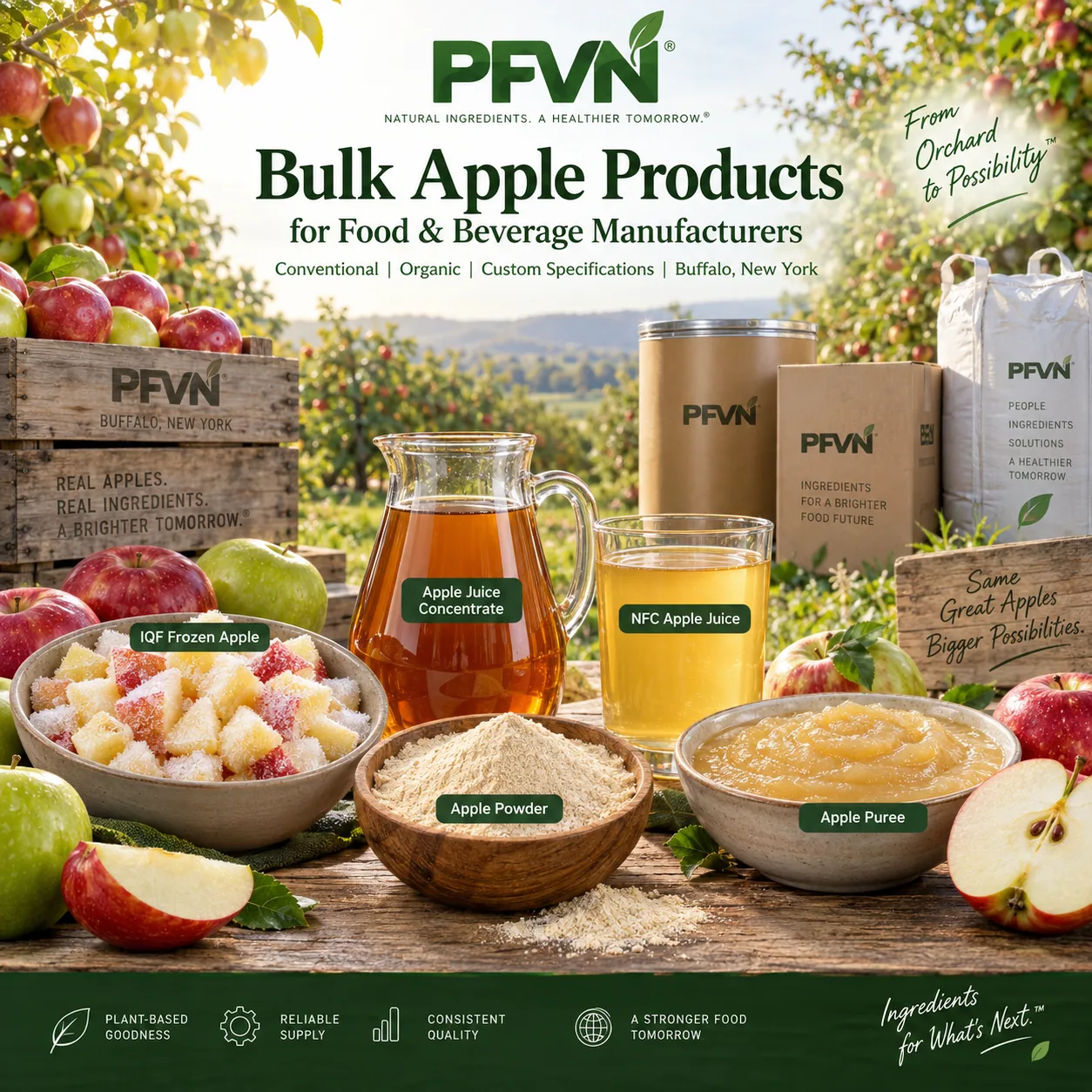
Depending on the formulation, apple may also be sourced as juice concentrate, NFC juice, IQF frozen pieces or powder when a different concentration, texture, moisture level or handling format is preferred.
Select packaging according to batch volume, storage conditions, thawing or pumping requirements, line rate and unloading equipment. Exact formats depend on the processor and product program.
Useful for trials and smaller manufacturing runs. Depending on the supplier, these may be offered in frozen or other suitable commercial configurations.
A common industrial scale for aseptic or frozen puree programs. Actual fill weight, liner construction and pallet configuration vary by source.
Potentially suitable for higher-volume pumpable programs when the product, processor and filling system support bulk tote supply.
Selected programs may use bag-in-box, lined-carton or frozen block configurations where smaller handling units or easier portioning are preferred.
Include the application, target °Brix, pH or acidity where relevant, consistency or sieve requirement, certification, quantity, packaging, delivery location and timing. These details help match your inquiry with the appropriate commercial product and specification.