
About 10–15 kg
Barrier bags in cartons are commonly used where protection from moisture, oxygen and light is important.
Bulk Butternut Squash Powder for industrial buyers seeking a shelf-stable dry vegetable ingredient for dry mixes, prepared foods, bakery systems, seasonings, nutrition products and specialty formulations. PFVN supports conventional and organic sourcing programs for North American food and beverage manufacturers, with powder characteristics, packaging and documentation matched to individual procurement requirements.
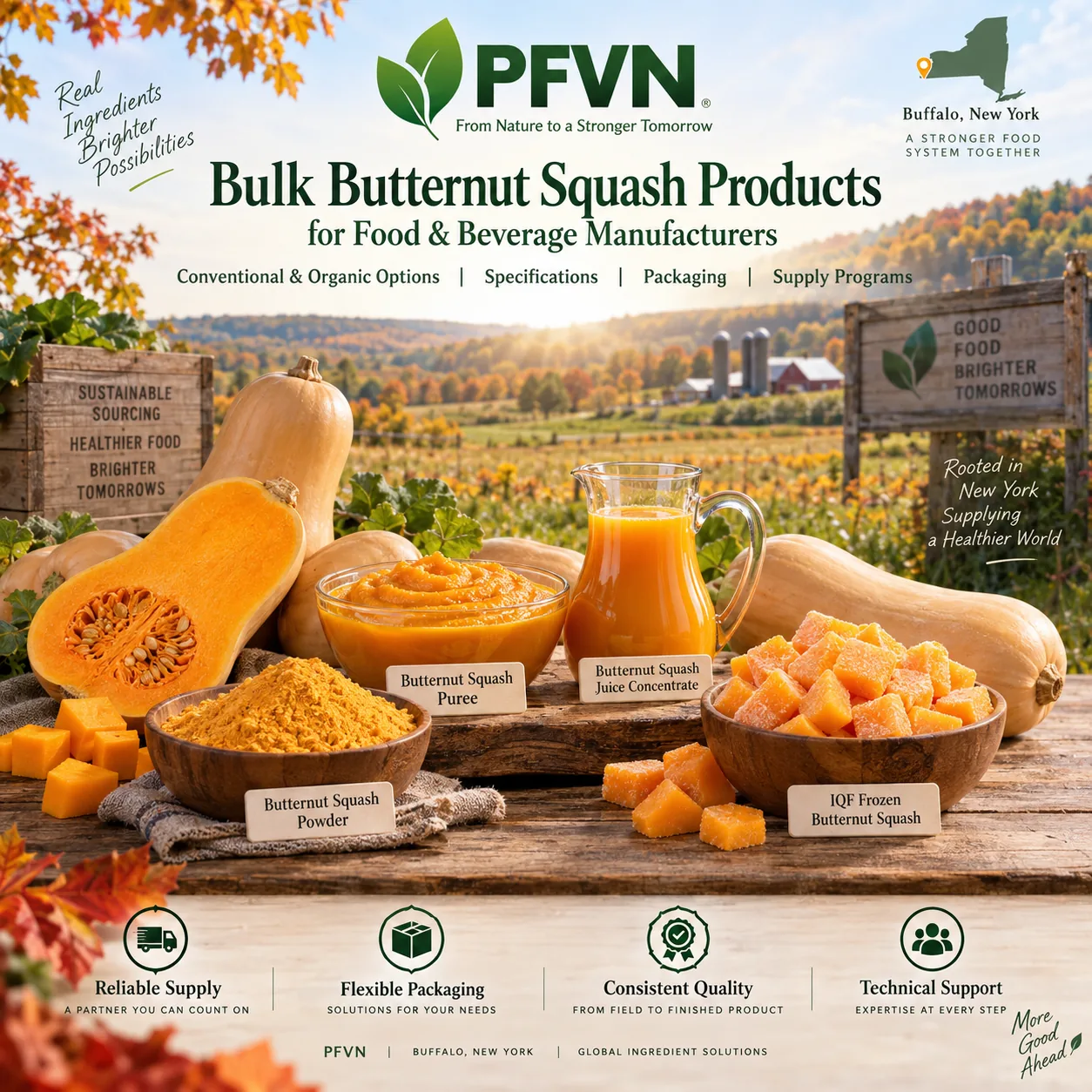
PFVN supplies butternut squash in powder form for qualified food, beverage and ingredient programs. Powder offers manufacturers a dry-format alternative to puree or frozen squash and can be particularly useful where reduced water content, convenient dry blending, controlled dosing and ambient ingredient handling are important.
Butternut squash powder may contribute characteristic vegetable flavor, natural yellow-orange color, dry vegetable solids and mild sweetness to finished formulations. Depending on the production process, powders may be produced from processed squash using dehydration technologies designed to remove moisture while converting the vegetable into a stable, free-flowing ingredient suitable for further blending or formulation.
Powder properties can vary significantly by processor and manufacturing method. Buyers should therefore evaluate parameters such as particle size, moisture, bulk density, color, flavor profile, dispersibility, carrier content and microbiological limits against the needs of the finished product.
Qualification of vegetable powders commonly includes physical, analytical and functional properties in addition to food-safety documentation. The most important parameters depend on how the powder will be processed and used in the final formulation.
Powder can simplify formulation where a dry ingredient is preferred over puree or frozen vegetables. It can be weighed directly into dry blending systems and incorporated into premixes, seasonings, dough systems, fillings, soups and other formulated products without introducing the same amount of water associated with puree.
The concentrated dry format may also reduce refrigerated or frozen storage requirements, depending on the specification and packaging. For manufacturers producing powdered mixes or low-moisture foods, this can improve compatibility with existing ingredient-handling systems.
Because vegetable powders may absorb moisture from the surrounding environment, proper packaging and storage are important. Product should generally remain sealed and protected from excessive humidity, heat and direct light according to the supplier's stated storage conditions.
Butternut squash powder can be incorporated into dry or semi-dry formulations where manufacturers want vegetable solids, color and squash character without using a high-moisture ingredient. Final inclusion level and processing performance should be established through application testing.
In addition to dedicated powder systems, butternut squash powder may be evaluated in formulations where vegetable solids, color or characteristic squash flavor are desirable and the manufacturer prefers a low-moisture ingredient format.
Packaging configuration depends on the supplier and powder program. Commercial powders are generally packed to help protect the ingredient from moisture, contamination and environmental exposure during transport and storage.
If powder is not the preferred format for your manufacturing process, butternut squash may also be sourced as frozen product, juice concentrate or puree.
Moisture-protective formats commonly used for fruit and vegetable powders for Bulk Butternut Squash Powder. Select package size around batch volume, storage, thawing or pumping needs, line rate and unloading equipment.
Barrier bags in cartons are commonly used where protection from moisture, oxygen and light is important.
A common industrial dry-ingredient format for free-flowing powders where appropriate.
Provides rigid protection and strong moisture control for powders during storage and transport.
Useful for evaluation, pilot production and high-value powders; availability depends on the supplier program.
Include the intended application, required particle size or mesh, carrier restrictions, certification requirements, estimated quantity, packaging, delivery location and target timing. If you already have a technical specification or benchmark powder, include the relevant parameters so the supply program can be evaluated more efficiently.