
5-gallon or roughly 15–25 kg pails
Useful for trials and smaller manufacturing runs. Depending on the supplier, these may be available as frozen or other suitable puree formats.
Bulk butternut squash puree is a smooth vegetable ingredient used by industrial food manufacturers for soups, sauces, baby food, prepared meals, bakery, nutrition products, dips and frozen foods. It contributes the characteristic orange color, mild sweet-squash flavor, vegetable solids and creamy body of butternut squash while reducing the washing, peeling, seed removal, cooking and milling required when processing whole squash in-house.
Butternut squash belongs to Cucurbita moschata. Botanically it is the fruit of the squash plant, although commercially and culinarily it is handled as a vegetable. Mature butternut squash develops a tan outer rind and dense orange-yellow flesh with a relatively mild, slightly sweet flavor.
The orange flesh contains naturally occurring carotenoid pigments, including carotenes that contribute to its characteristic color. The flesh also contains water, carbohydrates, soluble and insoluble vegetable solids and structural components that influence the body and consistency of the resulting puree.
Cultivar, maturity, growing conditions and storage before processing can influence moisture, soluble solids, color, sweetness and texture. Published research on fresh butternut squash has reported soluble-solids values around 8–10.5°Brix in selected samples, illustrating why commercial puree should be purchased against a defined specification rather than a generic product name.
Commercial butternut squash puree is typically produced by preparing the edible flesh, applying the required cooking or thermal process and refining the material to a controlled puree consistency. The resulting ingredient can be dosed directly into manufacturing systems according to the supplier's handling instructions.
Butternut squash has a comparatively mild vegetable flavor with natural sweetness, allowing it to work as both the principal flavor and as a supporting base for seasonings, dairy ingredients, grains, proteins and other vegetables.
The orange-yellow flesh provides natural color to soups, sauces, fillings, prepared foods and nutrition products. Color intensity can vary according to cultivar, maturity and thermal processing.
Puree contributes suspended vegetable solids and body, helping create creamy, spoonable or sauce-like textures without requiring the manufacturer to process whole squash from raw material.
A commercial puree format can reduce on-site washing, peeling, trimming, seed removal, cooking, milling and solid-waste handling while improving batch-to-batch dosing consistency.
Exact specifications vary by processor and supply program. Technical approval should be based on the current product specification, representative samples and the requirements of the finished application.
Soluble solids and total solids affect natural sweetness, vegetable-solids contribution, yield and finished-product body. Raw-material studies have shown that butternut squash can vary materially in soluble solids, so buyers should define acceptable commercial limits when this parameter is important.
Butternut squash is generally a low-acid vegetable. Research examples on butternut-type squash puree have reported pH values around 6, rather than the more acidic range typical of many fruit purees. The actual product pH must be confirmed because it can be important to thermal-process design and formulation.
Consistency influences pumping, mixing, depositing and finished-product mouthfeel. Qualification may include viscosity, flow or another defined consistency method appropriate to the product and manufacturing system.
Mechanical refining determines the size and amount of retained vegetable particles and fibers. Fine puree may be preferred for smooth soups, baby foods and sauces, while other prepared foods may tolerate a heavier-bodied finish.
Color should be characteristic of processed butternut squash and reasonably uniform within the agreed specification. Cultivar, maturity, oxygen exposure, heat treatment and storage can influence orange and yellow color intensity.
Commercial evaluation may include characteristic cooked-squash flavor, mild sweetness and absence of fermented, scorched, oxidized or otherwise objectionable sensory notes.
Specifications may define limits for aerobic plate count, yeast and mold, coliforms and relevant pathogens. Acceptance criteria depend on the preservation process, package format and intended end use.
Buyers should confirm whether the offered material is 100% butternut squash puree or includes any permitted ingredients or processing aids. The composition must meet formulation, labeling and certification requirements.
Butternut squash differs from naturally acidic fruit purees. Its relatively high natural pH means that shelf-stable processing cannot be approached in the same way as a high-acid fruit ingredient. The processor's validated thermal process, package system and storage conditions are therefore important parts of product qualification.
Depending on the supplier and commercial format, puree may be thermally processed and aseptically filled, frozen after processing, or supplied under another validated preservation system. Buyers should confirm the exact process category rather than assuming that all butternut squash purees have the same storage conditions or shelf life.
Manufacturers should also validate how the puree behaves during their own downstream process, particularly in retorted meals, hot-filled sauces, pasteurized soups, frozen foods or products that undergo additional heating after formulation.
Butternut squash puree is particularly useful where manufacturers need vegetable flavor, orange color, solids and creamy body in a standardized, pumpable ingredient format. The final specification should be selected around the texture, processing conditions and sensory targets of the finished product.
A major application for squash puree, including creamy soups, bisques, seasonal soup bases and blended vegetable systems where puree contributes both flavor and body.
Application guide → Sauces Sauces & CondimentsUsed in creamy vegetable sauces, pasta sauces, cooking sauces, seasonal sauces and savory preparations where squash provides color, mild sweetness and viscosity.
Application guide → Infant food Baby Food ManufacturingSmooth butternut squash puree is suitable for single-vegetable and blended baby-food formulations, subject to the manufacturer's particle-size, microbiological and process requirements.
Application guide → Plant-based Plant-Based Food FormulationSquash puree can contribute vegetable solids, moisture and body to plant-based fillings, side dishes, blended vegetable products and other formulated foods.
Application guide → Prepared foods Prepared Foods & Ready MealsUsed in frozen or refrigerated meals, grain bowls, vegetable side dishes, filled pasta components and other prepared-food systems requiring consistent squash content.
Application guide → Prepared foods Dips & SpreadsCan be blended with dairy or plant-based ingredients, herbs, spices and other vegetables to create smooth dips, sandwich spreads and seasonal formulations.
Application guide →The combination of mild flavor, natural color and vegetable solids allows butternut squash puree to function in several adjacent product categories without requiring manufacturers to handle whole squash.
Puree can be incorporated into breads, muffins, cakes, pastries, pies and seasonal bakery fillings where vegetable solids, moisture and squash flavor are desired.
Butternut squash puree can be formulated into frozen vegetable sides, meal components and sauces where smooth texture and repeatable portioning are important.
Its smooth consistency can support vegetable-forward pouches and blended nutrition foods, subject to the nutritional, microbiological and regulatory requirements of the finished product.
The mild flavor can be combined with apple, pear, carrot, sweet potato or other ingredients in blended products requiring balanced sweetness, color and vegetable solids.
Processing whole butternut squash requires receiving, washing, peeling or rind removal, seed removal, trimming, cutting, cooking, size reduction and waste management. A qualified commercial puree transfers many of these preparation steps to the ingredient processor.
This can simplify production planning and make vegetable addition easier to meter into soups, sauces, fillings, ready meals and other formulated products. A controlled puree specification can also improve repeatability compared with processing different lots of whole squash directly at the manufacturing plant.
The puree still needs to be evaluated in the actual formulation. Starches, proteins, fats, gums, dairy ingredients, salts and thermal processing can all change apparent viscosity, flavor and final texture.
Commercial suitability involves more than analytical values. Buyers should also confirm production format, certification, origin, packaging, minimum order quantity, lead time and continuity of supply.
Both conventional and certified-organic supply may be available depending on processor, origin and crop. Organic documentation and certification scope should be verified before commercial approval.
Origin can influence crop calendar, variety, color, solids and commercial availability. Buyers with origin restrictions should state them during the initial inquiry.
Minimum quantities may differ between stocked product, production runs and organic programs. Trial quantity, expected annual volume and delivery frequency help determine the appropriate supply option.
Seasonality and production schedules can affect availability. High-volume or year-round users should discuss forecasts, inventory planning and acceptable alternative origins or processors where appropriate.
Packaging availability depends on the processor and supply program. The selected format should match warehouse conditions, production batch size, pumping or thawing capability, line rate and expected consumption after opening.
Aseptically processed puree may be filled into sterile barrier bags inside drums, bins or other approved outer containers. Where the specification permits, unopened product may be stored and transported without a frozen supply chain.
Frozen puree requires temperature-controlled storage and transportation. Manufacturers should account for freezer capacity, thawing time and post-thaw handling in their production planning.
Industrial receiving procedures may verify package integrity, lot identity, net weight, product condition, storage temperature where applicable and required documentation before release.
Confirm unit weight, units per pallet, pallet dimensions, loading pattern, shipping temperature and destination requirements when evaluating delivered commercial cost.
Because butternut squash is an agricultural product, normal variation may occur between crops and lots. Commercial acceptance criteria help distinguish normal variation from parameters that could materially affect the finished product.
Specifications may address °Brix or total solids, pH, consistency, color, sensory characteristics, microbiological limits and physical defects. Buyers with specific analytical methods or internal limits should provide them during supplier qualification.
Lot-specific Certificates of Analysis may be requested where required by the customer's quality system. Documentation availability varies by supplier and program.
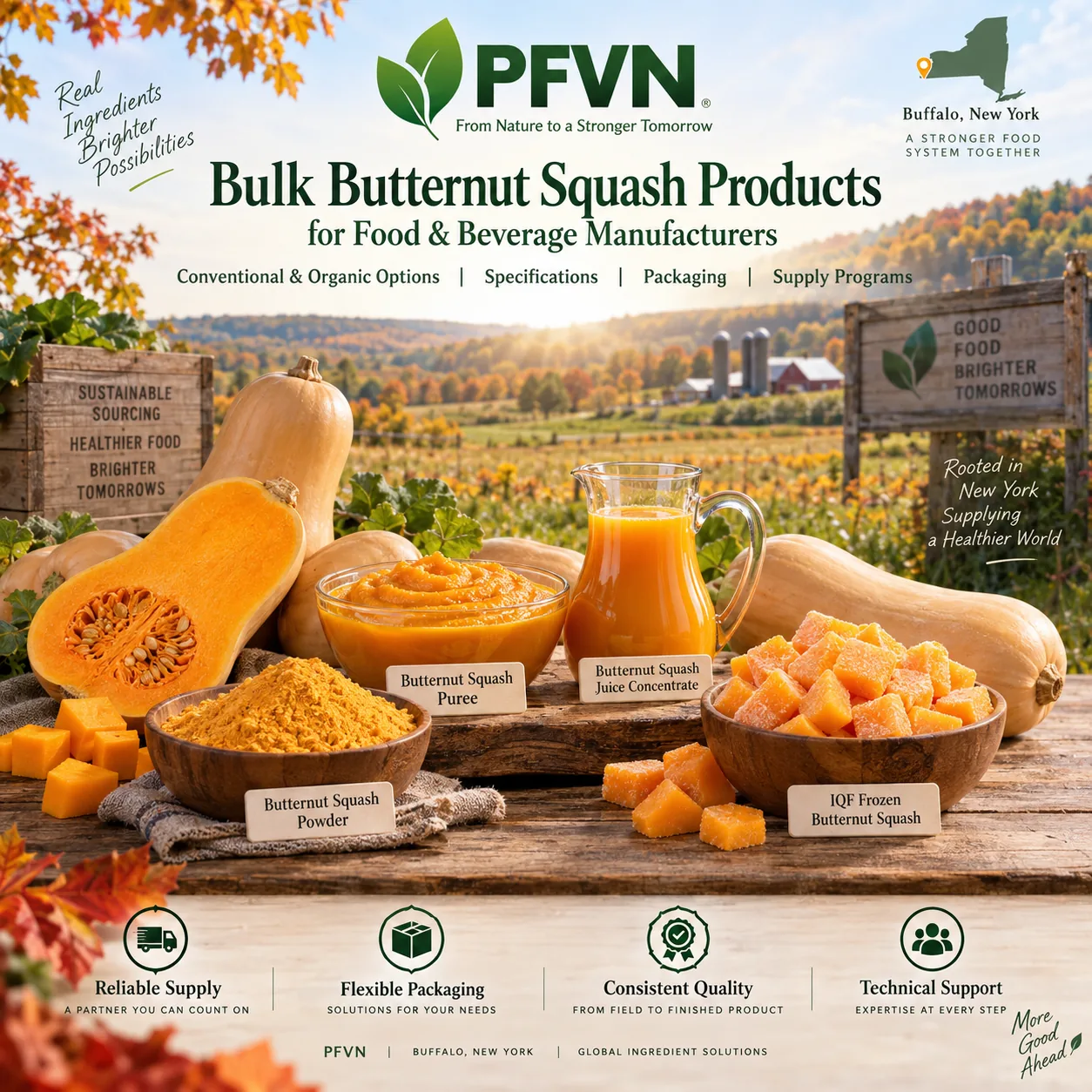
Depending on the manufacturing process, butternut squash may also be sourced as IQF frozen pieces, concentrated ingredients or powder when a different texture, moisture level, solids concentration or handling format is preferred.
Select package size around production volume, storage conditions, thawing or pumping requirements, line rate and unloading equipment. Exact availability depends on the processor and supply program.
Useful for trials and smaller manufacturing runs. Depending on the supplier, these may be available as frozen or other suitable puree formats.
A common industrial scale for aseptic or frozen puree supply. Actual net weight, liner construction and pallet configuration vary by processor.
May be used for pumpable higher-volume programs where the product, processing system and filling technology support bulk tote supply.
Selected programs may use bag-in-box, lined-carton or frozen block configurations where smaller handling units and easier portioning are preferred.
Include the intended application, required °Brix or solids, pH requirement where relevant, texture or sieve target, estimated quantity, packaging format, certification, delivery location and timing. If you already have a technical specification or benchmark product, include the relevant parameters so the supply program can be evaluated efficiently.