
1–5 kg bags or pail-scale formats
Useful for foodservice, trials and smaller manufacturing runs. Commercial frozen avocado pulp is widely supplied in portioned flexible bags, allowing manufacturers to thaw only the amount needed for production.
Bulk avocado puree is a rich, smooth fruit ingredient used by food manufacturers for characteristic avocado flavor, creamy texture, natural oil content and substantial fruit body. Major applications include guacamole, dips, sauces, dressings, prepared foods, plant-based products, frozen foods and specialty formulations. PFVN supports industrial buyers with conventional and organic programs, texture and color requirements, technical specifications, packaging, documentation and commercial supply options.
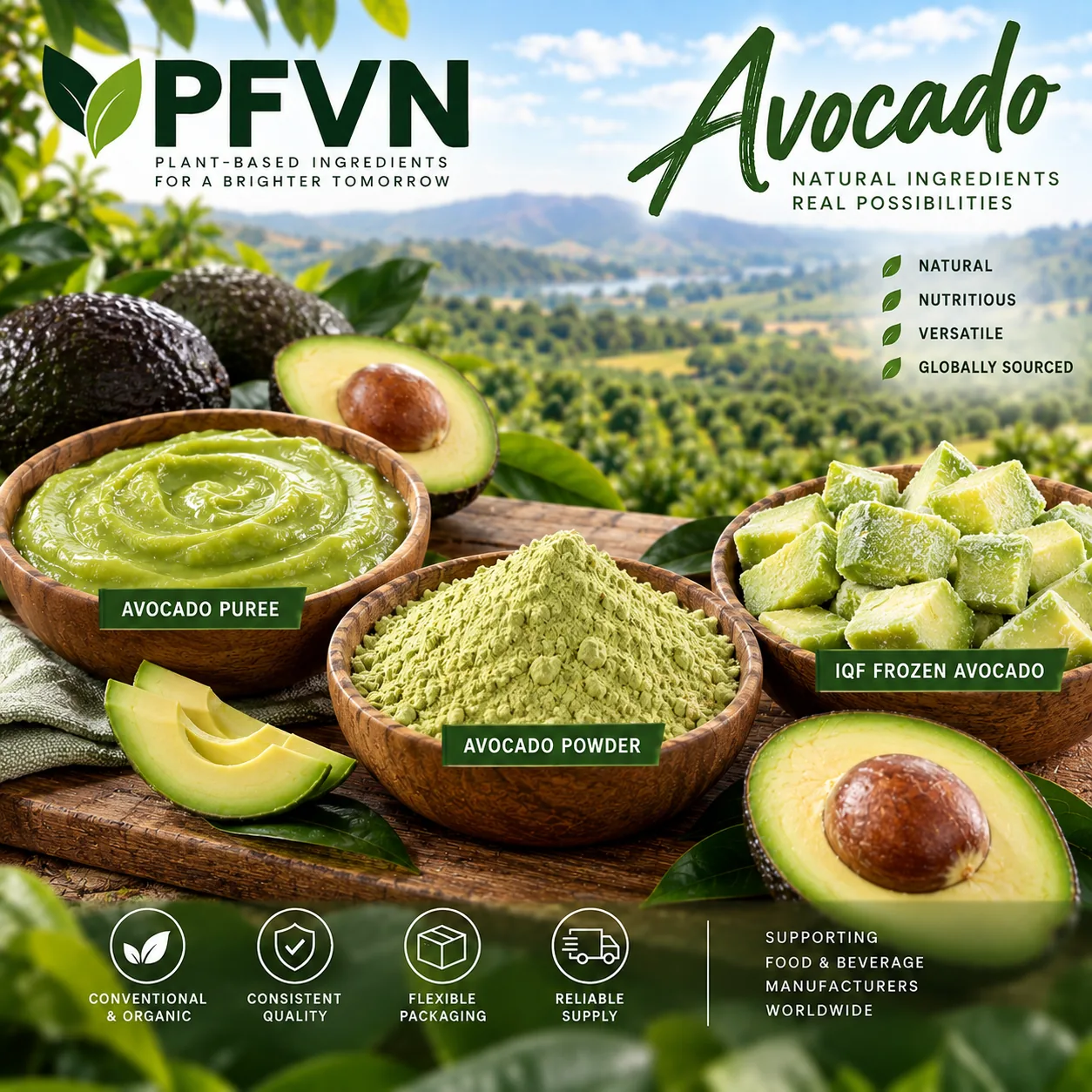
Avocado, botanically Persea americana, is a large-seeded fruit with a creamy edible pulp surrounding a central pit. Unlike most fruit ingredients, avocado is relatively low in sugar and unusually rich in natural oil, giving the puree its dense mouthfeel and characteristic creamy texture.
Hass is the dominant variety in many commercial processing programs because of its flavor, oil content and year-round international availability. Other cultivars can differ in flesh color, oil concentration, dry matter, texture and flavor and may therefore produce noticeably different puree.
Avocado is also a climacteric fruit. It is generally harvested firm and develops its desirable eating texture during controlled ripening. Commercial puree quality therefore depends strongly on fruit maturity: underripe fruit can be firm and less flavorful, while overripe material can create darker color and weaker texture.
Commercial avocado ingredients can differ substantially in composition and texture. Buyers should define whether the formulation requires 100% avocado, an acidified puree, or a pulp with retained avocado pieces.
Some frozen and HPP commercial programs contain only avocado. These products are useful where a simple ingredient declaration and natural avocado flavor are important.
Other products use citric acid, lime, ascorbic acid or another permitted acidification or antioxidant system to support color, flavor and process stability. Ingredient declaration should always be confirmed.
Puree can be finished smooth for sauces and prepared foods or supplied with controlled avocado pieces for guacamole, dips and products where a more hand-prepared texture is desired.
Frozen storage and high-pressure processing are widely used for avocado because they can support microbiological control while avoiding the severe heat exposure that may negatively affect fresh avocado flavor.
Unlike many fruit purees, °Brix is not usually the primary commercial measure for avocado. Industrial buyers more often focus on oil or fat content, dry matter, pH, consistency, color, particle profile, oxidation stability and sensory characteristics.
Natural oil is an important contributor to avocado's creamy texture and rich mouthfeel. Current commercial Hass pulp examples specify minimum oil levels around 9%, while some programs use broader ranges depending on variety, maturity and product style.
Dry matter is closely related to avocado maturity and processing behavior. Higher dry matter generally produces denser, richer pulp, while lower-solids fruit may create a softer or more watery puree. Supplier-specific solids targets should be reviewed when texture is critical.
Natural avocado pulp is relatively low-acid. One current 100% Hass commercial pulp program specifies pH 6.0 minimum. Acidified products can instead be formulated in approximately the upper-4 pH range. The distinction is important for both flavor and process design.
Puree may range from a fully smooth paste to a product containing controlled chunks. Commercial qualification should define whether the application needs a uniform fine puree, a thicker pulp or a minimum retained-chunk percentage.
High-quality avocado puree should retain characteristic green to yellow-green flesh color without excessive brown or gray oxidation. Color requirements are particularly important in guacamole, dips and visible prepared-food applications.
Commercial puree should provide clean, ripe avocado flavor without fermented, rancid, excessively bitter, oxidized or cooked off-notes. Because avocado is oil-rich, both enzymatic and oxidative deterioration can affect sensory quality.
Specifications may define limits for aerobic plate count, yeast, mold, coliforms and relevant pathogens. HPP, frozen and other commercial programs can use different microbiological acceptance criteria and shelf-life systems.
Confirm whether the product is 100% avocado or contains citric acid, ascorbic acid, lime juice, salt or other permitted ingredients. Composition can affect labeling, flavor, pH and finished-product formulation.
Once avocado flesh is cut, mashed or pureed, cellular structures are disrupted and polyphenol oxidase can contact naturally occurring phenolic compounds in the presence of oxygen. This can rapidly change attractive green pulp into brown or gray material.
Commercial processors manage this through combinations of oxygen exclusion, rapid processing, refrigeration or freezing, acidification, antioxidants, high-pressure processing and carefully controlled thermal treatments. The chosen process can materially affect color, flavor and shelf life.
Manufacturers should also minimize unnecessary air incorporation during mixing and transfer. Even a well-controlled incoming puree may darken after opening if it is exposed to oxygen for extended periods.
Avocado's combination of natural oil, fiber and suspended solids gives it very different rheology from berry or citrus puree. It can create substantial body and lubrication in sauces, dips and prepared foods without the high soluble-sugar content typical of many fruit ingredients.
High shear can make the puree smoother, while retained avocado pieces provide a more rustic guacamole-style texture. Formulation with water, acids, salt, oil, starches, proteins or hydrocolloids can also change viscosity and perceived richness.
Heating deserves particular attention. Avocado flavor can become less fresh or develop undesirable bitter or cooked notes under severe thermal conditions, so processors should validate the actual heat treatment required by the finished product.
Avocado puree is primarily used where manufacturers need creamy texture, natural avocado flavor, oil-rich mouthfeel and recognizable green fruit character. Its strongest industrial applications are savory foods rather than traditional sweet fruit products.
One of the largest uses for avocado puree. Smooth or chunky pulp provides the base for guacamole, avocado spreads, sandwich spreads and refrigerated or frozen dip systems.
Application guide → Sauces Sauces, Dressings & CondimentsAvocado puree provides creamy body and characteristic flavor in salad dressings, taco sauces, sandwich sauces, dipping sauces and avocado-based condiments.
Application guide → Prepared foods Prepared Foods & Ready MealsApplications include frozen meals, bowls, wraps, sandwich fillings, Mexican- style prepared foods, refrigerated meal components and avocado toppings.
Application guide → Plant-based Plant-Based Food FormulationAvocado can contribute plant-derived fat, creamy mouthfeel and binding properties to plant-based sauces, spreads, bowls and other vegetable-forward formulations.
Application guide → Culinary Soups & Culinary BasesPuree can add smoothness and avocado character to chilled soups, specialty culinary bases and selected creamy savory formulations. Process temperature should be evaluated for flavor and color retention.
Application guide → Purees Baby Food & Blended PureesFine avocado puree can be used in selected blended vegetable and fruit formulations where ingredient composition, smoothness, processing and microbiological specifications meet the manufacturer's requirements.
Application guide →Beyond guacamole and sauces, avocado puree is used in specialty formulations that benefit from its dense texture and natural oil content.
Puree and pulp can be incorporated into frozen dips, meal components, portion-controlled avocado products and frozen foodservice preparations.
Commercial pulp can provide consistent avocado coverage for sandwiches, burgers, wraps, tacos, bowls and breakfast applications without the labor and yield variability associated with preparing whole fruit.
Avocado puree may be used in selected smoothies and nutrition formulations where a creamy texture and mild flavor are desired. Its behavior differs substantially from conventional high-sugar fruit purees.
In some product-development programs, avocado puree can replace part of a conventional fat component while contributing moisture, fruit solids and a distinctive creamy mouthfeel. Finished-product testing remains essential.
Hass avocado is widely used in industrial processing, but even Hass puree can vary according to origin, harvest maturity, dry matter, controlled ripening and processing method. These differences can affect texture, green color, oil level and flavor.
Commercial comparisons should also distinguish 100% avocado pulp from acidified or seasoned products. A lower-cost puree containing water or other ingredients is not directly equivalent to a pure avocado product.
For larger programs, buyers should identify expected annual volume, preferred origin, acceptable process format, packaging, certification requirements and delivery schedule. Seasonal crop conditions can influence availability and pricing.
Frozen supply is particularly common for avocado pulp because low temperature helps manage quality and shelf life. HPP is also widely used in commercial avocado products to provide microbiological control while retaining a fresh-style sensory profile.
Frozen commercial products are commonly stored around -18°C or below. Current Hass pulp programs report frozen shelf lives from approximately 18 months to two years depending on process and package.
HPP uses high hydrostatic pressure rather than intensive conventional heat. It is used commercially for avocado pulp and guacamole where fresh-like texture, flavor and color are important.
Frozen pulp should generally be thawed under refrigeration according to the supplier's handling instructions. Refreezing after thawing is commonly discouraged because of quality and food-safety considerations.
Once a package is opened, exposed puree should be protected from unnecessary oxygen and held under the supplier's specified refrigerated conditions to limit browning and quality deterioration.
Microbiological limits depend on the preservation system and intended end use. Commercial specifications may establish limits for aerobic plate count, yeast, mold, coliforms and relevant pathogens together with process-specific requirements.
Physical acceptance criteria may address peel, pit fragments, fibers, brown or black oxidized material, foreign matter and unacceptable texture. Chunky products may also define a minimum or target percentage of retained avocado pieces.
Because avocado is high in natural oil, sensory inspection should include rancidity and oxidized flavor as well as normal avocado aroma, color and texture.
Depending on the formulation, avocado may also be sourced as IQF frozen pieces or powder when a recognizable piece-form ingredient or dry-format ingredient is better suited to production.
Avocado packaging should be selected around production volume, frozen-storage capacity, thawing practices, oxygen protection and usage rate. Smaller packs are common because they reduce the amount of puree exposed to air after opening.
Useful for foodservice, trials and smaller manufacturing runs. Commercial frozen avocado pulp is widely supplied in portioned flexible bags, allowing manufacturers to thaw only the amount needed for production.
A common avocado-pulp format uses multiple sealed 1–4 lb or similar bags within a master case. This can reduce exposure of unused product and simplify refrigerated thawing.
Larger commercial formats may be available for higher-volume manufacturing. Exact net weight, liner construction and frozen-storage requirements vary by processor and should be confirmed during quotation.
Frozen avocado normally requires storage around -18°C or below. After thawing, the product should be held refrigerated and used within the supplier's defined time while minimizing exposure to air.
Include the application, Hass or other variety preference, smooth or chunky texture, oil or solids requirement where relevant, pH or acidification requirement, color expectations, conventional or organic program, quantity, packaging, delivery location and timing.