
Approximately 28–32° Brix
A common commercial range for lychee concentrate retaining some suspended fruit material. These products generally preserve more of the visual and textural characteristics associated with the original juice.
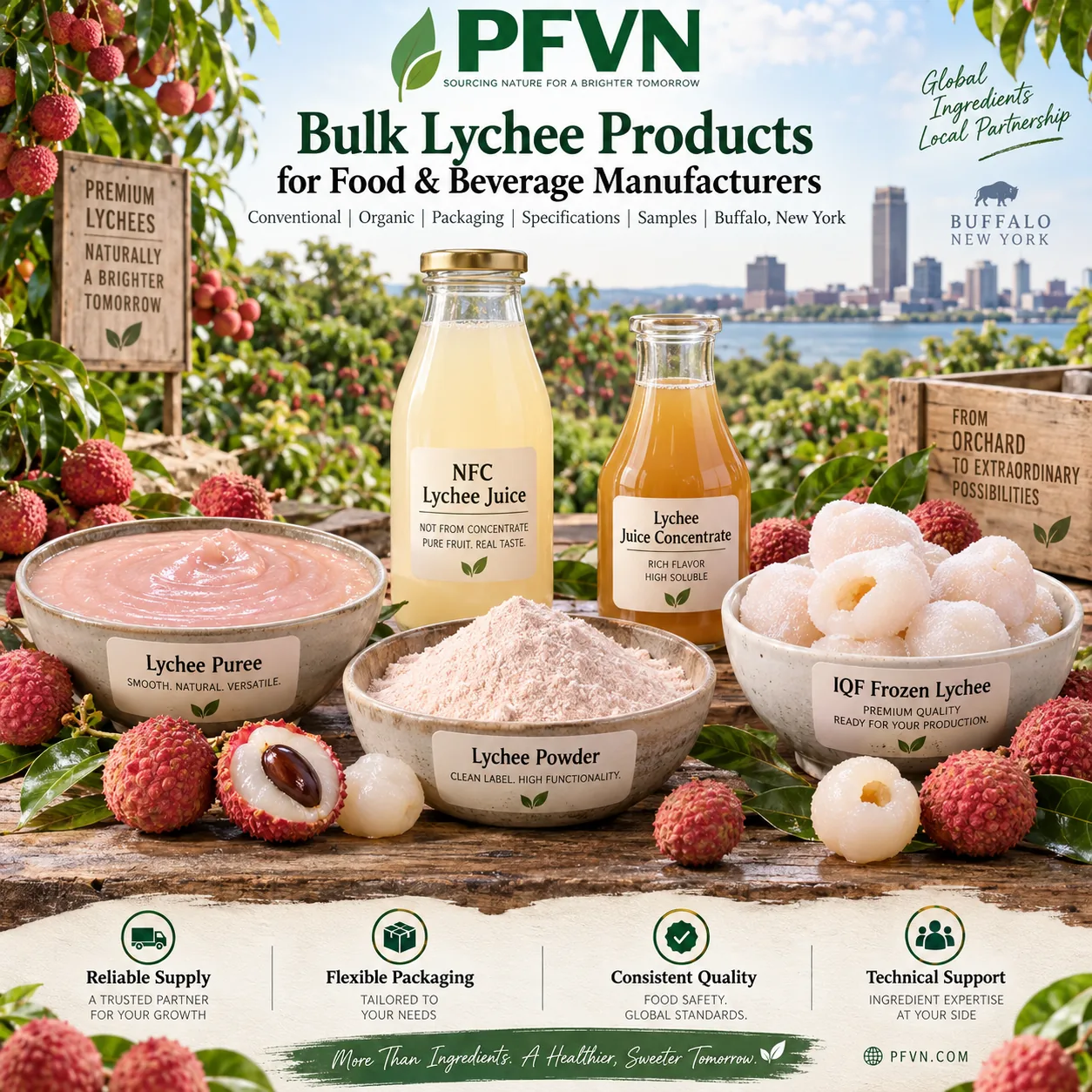
Bulk Lychee Juice Concentrate is a concentrated fruit ingredient produced from the aromatic flesh of lychee (Litchi chinensis). It delivers characteristic sweet, floral and tropical lychee notes in an efficient liquid format for beverages, juice blends, dairy products, frozen desserts, confectionery, bakery fillings, fruit preparations and flavor systems. PFVN supports industrial buyers with specification matching, documentation, packaging and commercial supply requirements.
Lychee, also spelled litchi, is the fruit of Litchi chinensis, a subtropical evergreen tree in the Sapindaceae family. The fruit has a textured red to pink outer shell surrounding a translucent white edible aril and a central seed. Its distinctive sensory profile combines sweetness with delicate floral, perfumed and tropical fruit notes.
For industrial juice concentrate production, the edible fruit portion is separated from the peel and seed before juice extraction and concentration. Removing part of the naturally occurring water increases soluble solids and reduces the volume that must be stored, transported and incorporated into a formulation compared with single-strength juice.
Lychee is especially valued in formulations where its recognizable aromatic profile is important. Because the flavor is relatively delicate compared with strongly acidic or deeply colored fruits, processing temperature, storage condition, oxygen exposure and blending partners can materially influence the finished sensory result.
Lychee juice concentrate does not have one universal Brix. Commercial products can range from moderately concentrated cloudy or pulpy juice to highly concentrated clarified juice. Buyers should therefore specify both the required concentration and physical style instead of purchasing on the product name alone.
A common commercial range for lychee concentrate retaining some suspended fruit material. These products generally preserve more of the visual and textural characteristics associated with the original juice.
Selected clarified lychee concentrates are produced at substantially higher soluble-solids levels. They provide greater concentration and lower shipping volume but differ from lower-Brix cloudy products in processing, flavor impact and reconstitution.
Commercial pH and acidity vary considerably by fruit, process and whether the product is acidified. Buyers should request actual pH, acidity expressed as the specified acid and any acidulants included in the ingredient statement.
Pulp content can range from essentially absent in clarified concentrate to measurable levels in cloudy products. Appearance, turbidity and pulp criteria should be defined when they affect the finished beverage or food.
A suitable concentrate should show clean, characteristic lychee flavor and aroma without fermented, caramelized, scorched or other objectionable notes. Sensory approval is especially important for premium beverage and flavor applications.
Industrial specifications normally establish limits for total plate count, yeast, mold and relevant pathogens. Limits and testing methods depend on the supplier, processing system and intended market.
The most important commercial distinction is whether the manufacturing program needs a clarified high-solids concentrate or a lower-Brix cloudy concentrate with more fruit character. The correct choice depends on the finished application, desired mouthfeel, target dilution, processing system and landed-cost calculation.
Qualification should cover Brix, acidity, pH, color, aroma, pulp or turbidity, ingredient statement, microbiological limits, processing method, storage temperature and shelf life. Reconstitution requirements should also be established because the amount of water required to reach the target single-strength or formulation Brix differs greatly between 30° Brix and 65° Brix concentrates.
Lychee is a seasonal fruit, so industrial programs should also consider origin, crop availability, contracted volume, production timing and inventory strategy. For continuous manufacturing, buyers may need to plan purchases around crop processing periods or qualify more than one approved source.
Lychee concentrate is primarily used where manufacturers need recognizable lychee flavor and fruit solids in a standardized liquid ingredient. Its relatively delicate floral profile works especially well in beverages, dairy, desserts and fruit systems.
Used in lychee drinks, fruit nectars, mixed-fruit beverages, still drinks, sparkling beverages and other ready-to-drink products. It can be used as the main fruit component or blended with complementary tropical fruits.
Suitable for functional beverages, flavored waters and premium fruit drinks where manufacturers want a recognizable tropical profile with a softer, more floral character than many citrus or berry ingredients.
Lychee pairs well with tea, botanical and citrus profiles and is used in beverage bases, café and foodservice syrups, mocktail or cocktail mixers and other flavor-forward drink systems.
Used in yogurt fruit preparations, dairy beverages, cultured products and selected plant-based alternatives. Manufacturers should evaluate aroma retention, acidity balance and stability in the finished matrix.
Provides characteristic lychee flavor to ice cream, sorbet, frozen desserts and dessert sauces, either directly or as part of a prepared fruit base.
Used in gummies, fruit jellies, soft confectionery and other sweet systems where lychee flavor can be combined with sugar, acids and complementary natural flavors.
Applicable to bakery fillings, pastry components, dessert toppings and fruit preparations, normally as part of a formulated system designed to control Brix, viscosity, acidity and bake or storage stability.
Can serve as a fruit-derived component in compounded beverage bases, flavor systems, syrups and multi-fruit preparations where authentic lychee character is required.
Lychee's characteristic aroma is an important part of its commercial value, so R&D teams should assess more than soluble solids alone. Two products with similar Brix can perform differently in finished formulations because cultivar, maturity, concentration process, pulp level and aroma retention all influence sensory character.
In beverage development, the concentrate is normally diluted or incorporated according to target soluble solids, fruit content, sweetness and acidity. Lychee's naturally sweet and floral character can be balanced with citric or other food acids and is frequently paired with citrus, pineapple, mango, passion fruit, peach, pear, coconut, berry or tea profiles.
Thermal processing should be validated in the actual formulation because excessive heat exposure may reduce fresh-fruit aroma and change flavor character. Pilot trials should evaluate the product after pasteurization or other heat treatment as well as after the intended shelf-life period.
Documentation availability depends on the source and program. Buyers should identify mandatory technical, food-safety and certification requirements before commercial qualification.
Defines Brix, acidity, pH, sensory criteria, pulp or clarity, microbiological limits, packaging, storage conditions and shelf life for the specific product.
Provides lot-specific analytical results against the supplier's release specification and is commonly requested for incoming quality control.
Buyers should confirm whether the product is 100% lychee concentrate or contains permitted acidulants, antioxidants or other processing ingredients and request relevant allergen and GMO statements.
Organic, kosher, halal and recognized food-safety certifications may be available depending on the approved source and manufacturing program.
PFVN can support lychee sourcing in multiple formats depending on the required fruit character, solids level, processing method, storage system and finished application.
Industrial package selection depends on concentrate style, Brix, annual volume, batch size, frozen or aseptic storage requirements, thawing capability, pumping equipment and production rate.
Useful for product development, trials and smaller production runs. Commercial lychee concentrate programs may include pails or other smaller industrial packs depending on the source.
A common commercial format for lychee concentrate. Fill weights can vary significantly with Brix, density and supplier, with drum programs commonly ranging around 200–275 kg.
Many lychee concentrate programs are supplied frozen, particularly when flavor preservation and long-term storage are priorities. Product-specific freezing and thawing instructions should be followed.
Larger packaging or bulk arrangements may be possible for qualified volumes where the product, storage system and supplier's filling capability permit.
Include your application, required Brix, clarified or cloudy style, acidity or pulp targets, certification requirements, estimated quantity, packaging, delivery location and timing. These details help us identify the most suitable lychee concentrate program.