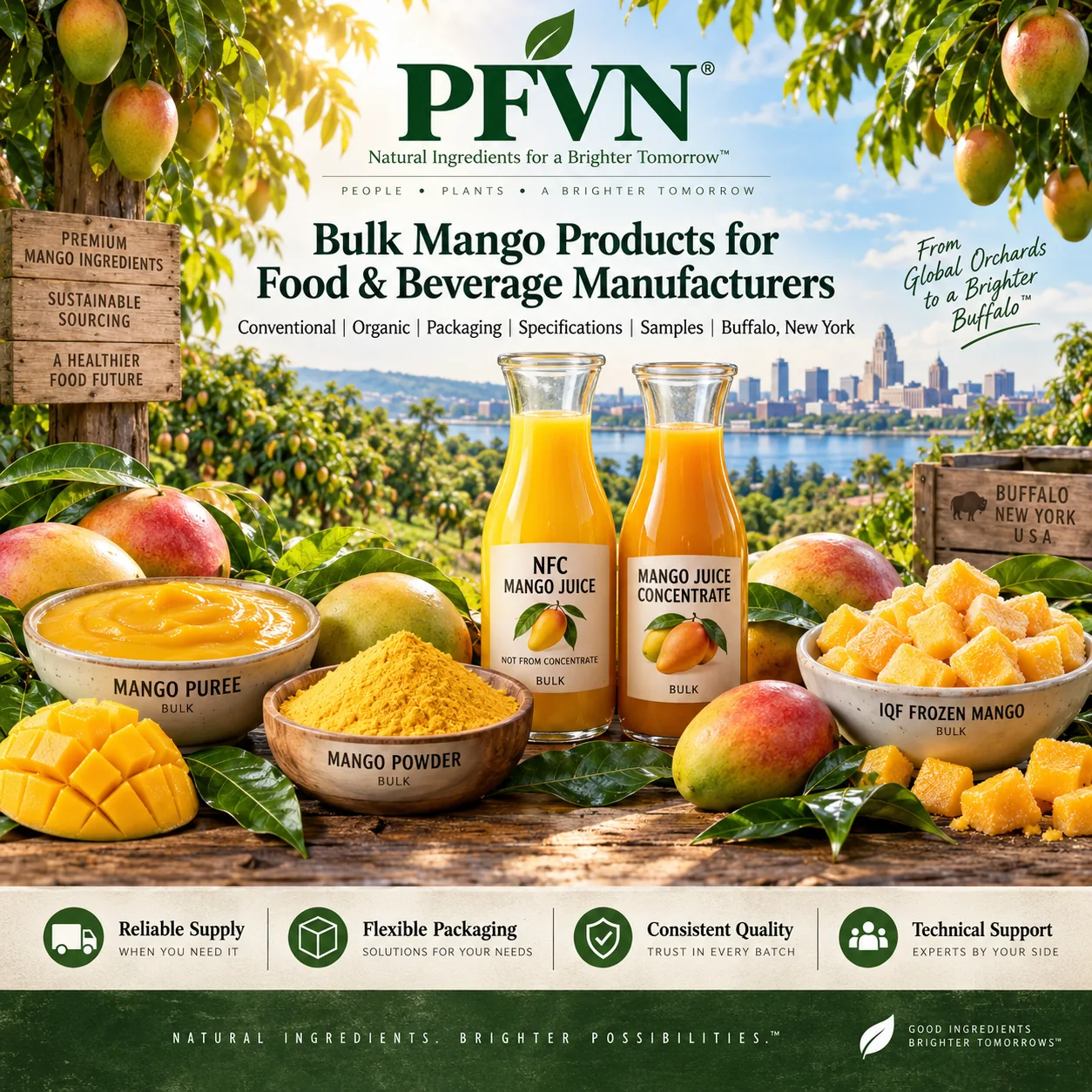
Juice Concentrates · Bulk B2B ingredients

Bulk Mango Juice Concentrate

Bulk Mango Juice Concentrate is a concentrated tropical fruit ingredient produced from ripe mangoes (Mangifera indica). It delivers characteristic sweet mango flavor, natural fruit solids and yellow-to-orange color in an efficient liquid format for juice and nectar production, smoothies, dairy products, frozen desserts, confectionery, bakery fillings, fruit preparations, sauces and industrial flavor systems.

Bulk industrial supply Pulpy & clarified programs Conventional programs Organic options Multiple origins & varieties Documentation on request
Bulk Mango Juice Concentrate
Fruit & ingredient profile

Mango character in a concentrated industrial format

Mango is the fruit of Mangifera indica, a tropical tree in the Anacardiaceae family. Botanically, mango is a drupe or stone fruit, with edible flesh surrounding a large central seed. Commercial varieties differ considerably in sweetness, acidity, fiber, aroma, flesh color and flavor intensity, making varietal selection relevant to industrial ingredient performance.

Ripe mango flesh typically ranges from yellow to deep orange and has a sweet, full-bodied tropical profile with cultivar-dependent floral, peach-like, citrus, resinous or honeyed notes. Industrial sourcing programs may identify varieties such as Totapuri, Alphonso, Kesar, Neelam or other regional cultivars and blends.

For concentrate production, sound ripe fruit is washed, peeled or processed, separated from the seed and converted into juice or pulp before water is removed under controlled conditions. Depending on the process, the resulting ingredient may retain substantial mango body and suspended solids or may be clarified and concentrated to a much higher Brix.

Product-style note: mango concentrate is not one standardized physical format. A pulpy 28–30° Brix mango concentrate behaves very differently from a clarified concentrate near 65° Brix. Buyers should specify the required style, Brix, viscosity or clarity and end application when requesting a quotation.
Technical & commercial specifications

Two important commercial concentrate styles

Mango concentrate specifications differ by variety, processing method and desired physical character. The ranges below are useful commercial reference points rather than universal PFVN specifications. Final purchasing decisions should always be based on the supplier specification and lot-specific Certificate of Analysis.

Pulpy concentrate

Approximately 28–30° Brix

A widely traded mango concentrate format, particularly for varieties such as Totapuri. It retains more suspended mango solids and body than clarified juice concentrate and is commonly used in beverages, dairy and confectionery.

Clarified concentrate

Approximately 64–66° Brix

Clarified mango juice can be concentrated to substantially higher soluble solids after enzyme treatment, extraction and clarification. This format is more fluid after reconstitution and is useful where reduced pulp and high concentration are required.

Single-strength reference

13.0° Brix U.S. reference

For U.S. juice-percentage calculations, FDA uses 13.0° Brix as the minimum single-strength reference for mango juice. Commercial reconstitution targets may vary according to specification and finished-product requirements.

Acidity & pH

Variety and process dependent

Pulpy 28–30° Brix commercial programs may be specified around pH 3.5–4.0 with acidity around or below approximately 1.2% as citric acid. Clarified 65° Brix products can have higher concentrated acidity and lower pH.

Physical properties

Pulp, clarity & viscosity

Pulpy mango concentrates can be relatively viscous and may require pump and line consideration. Clarified concentrates contain substantially less suspended material. Buyers should define consistency, pulp or turbidity where these affect processing.

Food safety

Microbiological criteria

Industrial specifications normally establish limits for total viable count, yeast, mold and relevant pathogens. Exact limits, test methods and sampling requirements should be agreed during supplier qualification.

Specification guidance: approximately 28–30° Brix pulpy concentrate and 64–66° Brix clarified concentrate represent two commercially important mango concentrate formats. They should not be treated as interchangeable ingredients. PFVN confirms the actual Brix, pH, acidity, pulp or clarity, microbiological limits and storage conditions against the product being offered.
Variety & sourcing

Mango variety matters in industrial formulation

Mango varieties can produce visibly and sensorially different ingredients. Totapuri is widely processed for industrial puree and concentrate programs and typically provides a practical balance of fruit yield, color and characteristic mango flavor. Alphonso is particularly valued for its rich orange color and distinctive aromatic profile, while Kesar, Neelam and other cultivars can provide different sweetness, acidity and flavor characteristics.

For a branded beverage or food product, buyers should decide whether maintaining one specific mango variety is commercially necessary or whether an approved multi-variety specification provides sufficient consistency. Variety-specific sourcing can improve sensory continuity but may create tighter seasonal or origin constraints.

Country of origin, harvest season, maturity at processing and crop conditions can also affect soluble solids, acidity, color and sensory profile. Long-term programs should therefore qualify both the analytical specification and the finished-product performance of the concentrate.

Industrial applications

Where mango juice concentrate is used

Mango concentrate combines recognizable tropical flavor, natural sweetness, fruit solids and yellow-orange color. Its versatility makes it a major ingredient across beverage, dairy, dessert, bakery and confectionery manufacturing.

Juices & nectars

Mango beverages & tropical blends

Used in mango juice drinks, nectars, smoothies and multi-fruit beverages. Mango also blends well with orange, pineapple, passion fruit, guava, peach, banana, coconut and other tropical ingredients.

Functional beverages

Wellness & nutritional drinks

Provides fruit solids, sweetness and familiar tropical flavor in functional drinks, fortified beverages, meal beverages and other formulations where mango can help balance less palatable functional ingredients.

Dairy

Yogurt & cultured products

Used in yogurt preparations, flavored milk products, cultured dairy beverages and plant-based dairy alternatives, often as part of a stabilized fruit preparation.

Frozen desserts

Ice cream, sorbet & gelato

Mango concentrate supplies tropical fruit flavor and color to ice cream, sorbet, frozen yogurt, gelato, popsicles and dessert sauces.

Confectionery

Gummies, jellies & candies

Applicable to gummies, fruit jellies, chews, hard candy centers and other confectionery where concentrated mango flavor and soluble solids are useful formulation components.

Bakery

Fillings, layers & toppings

Used in pastry fillings, cakes, dessert layers, glazes, fruit preparations and bakery toppings after formulation to the required Brix, acidity, viscosity and process stability.

Fruit preparations

Compotes, bases & inclusions

Can be incorporated into industrial fruit preparations for dairy, bakery, foodservice and dessert applications, either alone or in combination with mango puree and diced fruit.

Culinary & sauces

Dressings, chutneys & sauces

Mango concentrate also works in sweet and savory sauces, chutney-style products, marinades, dressings and culinary preparations where concentrated tropical sweetness and fruit acidity are desirable.

Application guides

Related manufacturing pathways

Formulation & processing

Working with mango concentrate

The appropriate dosage depends heavily on concentrate style. A 65° Brix clarified mango concentrate contributes much more soluble solids per kilogram than a 28–30° Brix pulpy concentrate, while the pulpy product may contribute considerably more body and characteristic mango texture.

Product developers should balance mango sweetness and flavor against acidity, finished Brix and the contribution of other fruits. Mango is frequently combined with higher-acid fruits such as passion fruit, citrus or pineapple to create a brighter flavor profile, while banana, coconut and dairy ingredients can produce a softer and creamier sensory character.

Heat treatment should be evaluated under actual commercial conditions. Excessive thermal exposure can alter fresh mango aroma and darken color, while high-solids pulpy concentrate can also require attention to thawing, mixing and pumping before production.

Quality & documentation

Common requirements for industrial approval

Technical-document availability depends on the producer and supply program. Buyers should identify required analytical, regulatory and certification documents during qualification rather than after commercial ordering.

Specification

Product data sheet

Typically defines Brix, pH, acidity, color, flavor, pulp or clarity, viscosity where applicable, microbiological limits, packaging, storage and shelf life.

Lot release

Certificate of Analysis

Provides analytical results for the production lot against the approved supplier specification and supports incoming quality-control procedures.

Regulatory

Ingredient & compliance statements

Ingredient declaration, allergen information, GMO status, country of origin and other regulatory statements can be requested according to customer and market requirements.

Certifications

Program documentation

Organic, kosher, halal and recognized food-safety certifications may be available depending on the source, production facility and selected mango concentrate program.

Same ingredient

Other Mango formats

Choose the mango format according to the required fruit character, texture, solids contribution, processing system and finished-product application.

Packaging & handling

Mango juice concentrate packaging

Industrial package selection should consider concentrate type, Brix, annual volume, batch size, viscosity, storage temperature, thawing requirements, pumping equipment and production rate.

Pilot / smaller production

Pails & bag-in-box

Smaller industrial packs may be available for product development, foodservice and lower-volume production programs. Exact pack size depends on product style and supplier.

Pulpy concentrate

Aseptic drums around 200–230 kg

Aseptic bag-in-drum packaging is widely used for approximately 28–30° Brix mango concentrate. Commercial examples include drum fills around 228 kg, although exact weight is supplier-specific.

Clarified concentrate

Frozen drums around 250–260 kg

High-Brix clarified mango juice concentrate is commonly supplied frozen, including programs around 65° Brix. Exact fill weight, liner configuration and storage requirements vary by source.

High-volume programs

Totes or other bulk formats

Larger formats may be available for qualified volumes where concentrate viscosity, stability, storage systems and the supplier's filling capability support bulk handling.

Storage: aseptic pulpy mango concentrate may be offered under ambient controlled-storage programs, while high-Brix clarified concentrate is frequently supplied frozen. The exact storage regime depends on processing and packaging and should always follow the supplier specification.
Handling: high-solids mango ingredients can become considerably more viscous at lower temperatures. Frozen or chilled material should be conditioned and mixed according to supplier instructions before pumping or dosing into production.
Shelf-life note: selected commercial mango concentrate programs specify shelf lives of up to approximately 24 months when unopened and maintained under the stated storage conditions. Shelf life is product-specific and should be confirmed for each quoted program.
Availability note: the package sizes above are industrial reference points, not a guarantee that every format is available for every variety, origin or specification. Confirm net weight, liner, pallet configuration, storage condition, minimum order quantity and lead time in the quotation.
Request a quote

Tell us what your mango program needs.

Include your application, required Brix, pulpy or clarified style, preferred mango variety or origin, acidity or sensory targets, certification requirements, estimated quantity, packaging, delivery location and timing. These details help us identify the most suitable mango concentrate program.

PFVN · Buffalo, New York
info@pfvn.us

We use your details only to respond to this inquiry.