
Roughly 15–25 kg pails or bag-in-box
Useful for trials, specialty production and smaller manufacturing programs. Selected commercial mango programs include approximately 20 kg aseptic bag-in-box formats.
Bulk mango puree is a tropical fruit ingredient used by food and beverage manufacturers for characteristic ripe-mango flavor, natural sweetness, yellow-to-orange color and substantial fruit body. Major uses include beverages, smoothies, dairy preparations, baby food, bakery fillings, frozen desserts, sauces and fruit preparations. PFVN supports industrial buyers with conventional and organic programs, variety-specific sourcing, technical specifications, industrial packaging and documentation.
Mango, botanically Mangifera indica, is a tropical stone fruit with a fleshy mesocarp surrounding a large central seed. Commercial puree is made from ripe fruit after washing, sorting, destoning, pulping and refining. The resulting ingredient retains soluble solids and fine fruit pulp that provide natural sweetness, viscosity and characteristic mango body.
Cultivar is commercially important. Alphonso is known for a rich aromatic profile and orange-yellow color, while Totapuri is widely used for industrial processing because of its availability, balanced flavor and good processing yield. Kesar and other varieties may also be offered depending on origin and crop.
Fruit maturity affects aroma, sweetness, acidity and texture. Underripe fruit can produce a more acidic or resinous profile, while appropriately ripened fruit develops the fuller flavor and color expected from commercial mango puree.
Commercial specifications vary by cultivar. Variety selection should be based on the required flavor intensity, color, soluble solids, acidity and finished product rather than price alone.
Alphonso puree is typically rich, aromatic and orange-yellow in color. Commercial programs commonly specify at least about 16°Brix, making it popular in premium beverages, dairy, desserts and confectionery.
Totapuri is widely processed for beverages and general food manufacturing. Commercial specifications commonly start around 14°Brix, with a yellow to golden-yellow appearance and balanced mango flavor.
Kesar and other regional mango varieties can provide different aromatic, color and acidity profiles. Availability depends strongly on producing region, crop season and processor.
Concentrated puree has part of its water removed and may be supplied around 28°Brix or other agreed concentrations. It can reduce shipped water and allow greater control over formulation solids.
Mango puree is generally qualified by variety, soluble solids, acidity, pH, consistency, finish, color, sensory profile and microbiological criteria. Exact requirements should be confirmed against the current supplier specification.
°Brix is a primary commercial parameter. Current market examples commonly specify Alphonso at about 16°Brix minimum and Totapuri at about 14°Brix minimum, although natural crop variation and supplier ranges apply.
Commercial natural mango purees commonly fall below approximately pH 4.0–4.2. Titratable acidity, often expressed as citric acid, helps define the balance between sweetness and tartness and can differ by cultivar.
Mango puree naturally has substantial body. Commercial programs commonly use Bostwick consistency as a control parameter, with examples in roughly the 8–15 cm per 30 second range depending on variety and processing method.
Finishing removes coarse fibers and residual peel or seed material. Fine, homogeneous puree is generally preferred for beverages and baby food, while other applications may tolerate a heavier fruit texture.
Mango color varies naturally by cultivar and maturity. Alphonso commonly shows deeper orange-yellow tones, while Totapuri is generally more yellow. Heat and storage can gradually reduce fresh color intensity.
Commercial puree should provide characteristic ripe-mango flavor without fermented, scorched, oxidized or excessive resinous notes. Sensory approval is especially important for variety-specific premium programs.
Specifications may establish limits for aerobic plate count, yeast, mold, coliforms and relevant pathogens. Requirements depend on preservation system, packaging and intended use.
Confirm whether the product is 100% mango puree or contains added sugar, water, acidulants or other ingredients. Natural puree should be distinguished from sweetened pulp and formulated mango preparations.
Unlike clarified mango juice, puree retains fine pulp and therefore adds viscosity, opacity and mouthfeel. This makes it particularly useful in smoothies, nectars, yogurt preparations, frozen desserts and fruit fillings.
Its naturally high viscosity can affect pumping, blending and filling, especially at lower temperatures. Manufacturers should evaluate the ingredient under actual processing conditions and confirm that pumps and transfer systems are suitable for the specified consistency.
Thermal processing can reduce some fresh mango aroma and alter color, so finished-product trials should reproduce the intended pasteurization, hot-fill, baking or retort process when sensory quality is critical.
Mango puree is one of the most widely used tropical fruit bases because it combines recognizable flavor, natural sweetness, attractive color and substantial fruit body.
Mango puree provides tropical flavor, viscosity and natural sweetness to smoothies, nectars, juice drinks, shakes and blended beverage bases.
Application guide → Purees Baby Food ManufacturingFine homogeneous mango puree can be used in single-fruit and blended pouches where particle size, acidity, ingredient composition and microbiological criteria meet the manufacturer's requirements.
Application guide → Dairy Fruit Preparations for YogurtMango is widely used in stirred yogurt, fruit-on-the-bottom systems, cultured dairy desserts and plant-based alternatives where its strong color and flavor provide clear product identity.
Application guide → Bakery Bakery Fillings & InclusionsPuree can form the fruit base for pastry fillings, cake layers, fruit preparations and dessert components where starch, pectin or other systems control final texture.
Application guide → Frozen desserts Frozen Dessert ManufacturingMango puree is widely used in sorbet, ice cream, gelato, frozen yogurt and fruit bars where its aromatic tropical character remains recognizable at frozen serving temperatures.
Application guide → Fruit preparations Jams, Preserves & Fruit SpreadsPuree contributes mango flavor, color and fruit solids to tropical spreads, dessert preparations and multi-fruit blends.
Application guide →Mango puree should not be evaluated solely on price per kilogram. Alphonso, Totapuri, Kesar and other varieties can differ materially in °Brix, acidity, aroma, color and consistency, which affects the amount required and the sensory result in the finished product.
Origin and crop season also matter. Mango processing is seasonal, while aseptic packaging allows puree produced during the harvest period to be distributed throughout the year. Larger programs should consider annual forecast, available crop volume and lead time as part of sourcing strategy.
Industrial buyers should also confirm conventional or organic status, ingredient composition, country of origin, package size and whether a specific variety is contractually required.
Commercial specifications may include °Brix, pH, titratable acidity, Bostwick consistency, color, black and brown specks, flavor and microbiological limits. Homogeneity and freedom from peel, seed fragments and foreign material are also important for smooth industrial puree.
Aseptic mango puree is commonly used for industrial supply because unopened drums can provide extended shelf life under supplier-specified storage conditions. Package integrity should be verified at receipt.
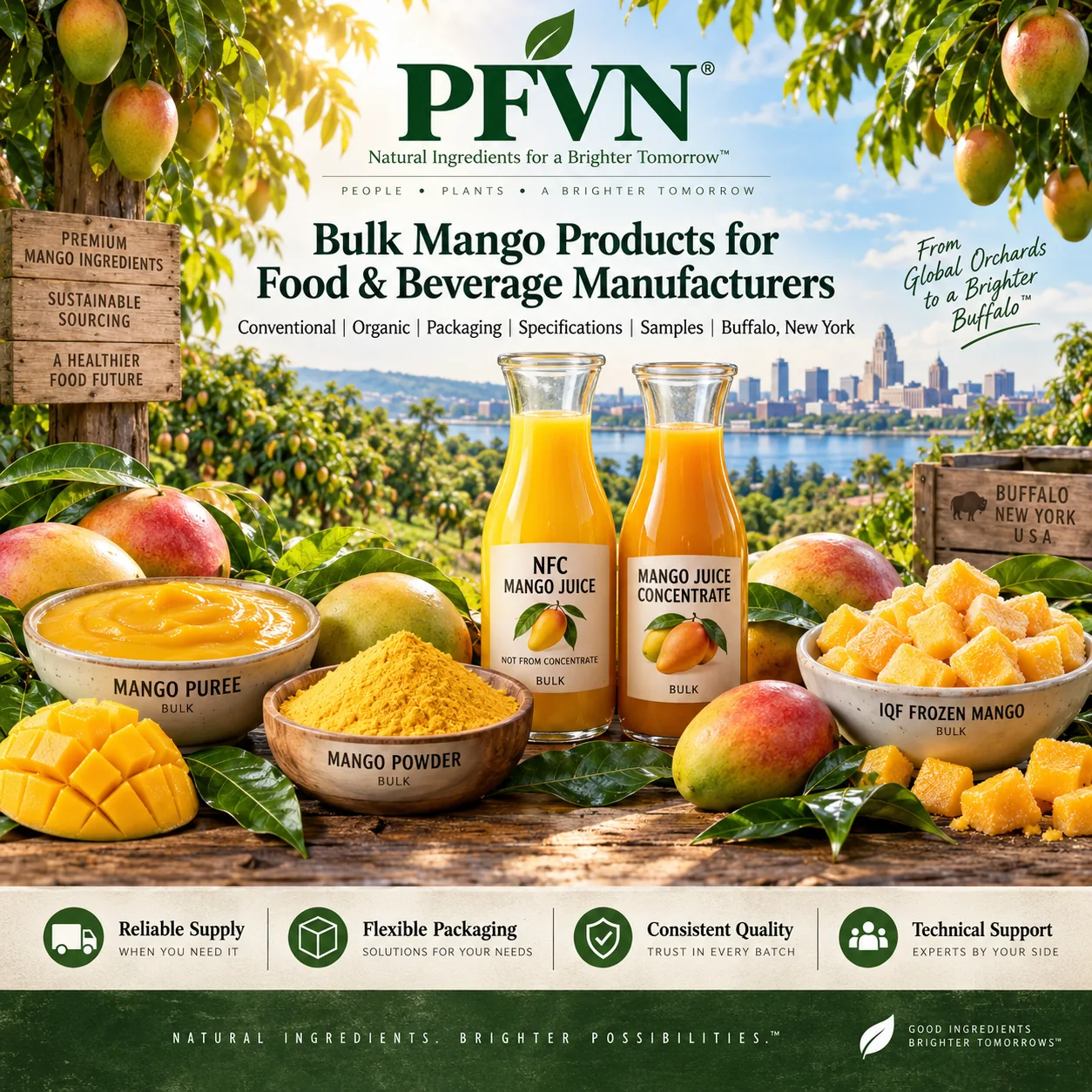
Depending on the formulation, mango may also be sourced as IQF frozen fruit, juice concentrate, NFC juice or powder when a recognizable fruit piece, concentrated liquid, single-strength juice or dry ingredient better suits the manufacturing process.
Aseptic bag-in-drum is one of the most common industrial formats for mango puree. Frozen and smaller bag-in-box or pail formats may also be available depending on variety, processor and commercial program.
Useful for trials, specialty production and smaller manufacturing programs. Selected commercial mango programs include approximately 20 kg aseptic bag-in-box formats.
A widely used format for natural-strength mango puree. Current Alphonso and Totapuri programs commonly use aseptic liners in steel drums at approximately 215–220 kg net weight.
Higher-solids mango concentrate may use slightly different drum fill weights. The exact net weight, °Brix and liner configuration should be confirmed for the source being quoted.
Mango puree is naturally thick. Pump selection, hose diameter, drum unloading, product temperature and production batch size should be considered when planning industrial handling.
Include the mango variety, application, target °Brix, pH or acidity, Bostwick or consistency requirement, conventional or organic program, estimated quantity, packaging, delivery location and timing. These details help identify an appropriate source and specification.