
Typically around 50° Brix
Many industrial passion fruit juice concentrates are standardized at approximately 50° Brix, commonly with a tolerance near ±1–2° Brix. Buyers should specify whether direct or corrected Brix is required for approval.
Bulk Passion Fruit Juice Concentrate is a high-impact tropical fruit ingredient produced from passion fruit (Passiflora edulis). Its intense aroma, pronounced sweet-tart character and naturally high acidity make it especially useful in juices, nectars, functional beverages, tropical blends, dairy products, frozen desserts, confectionery, bakery preparations, sauces and industrial flavor systems.
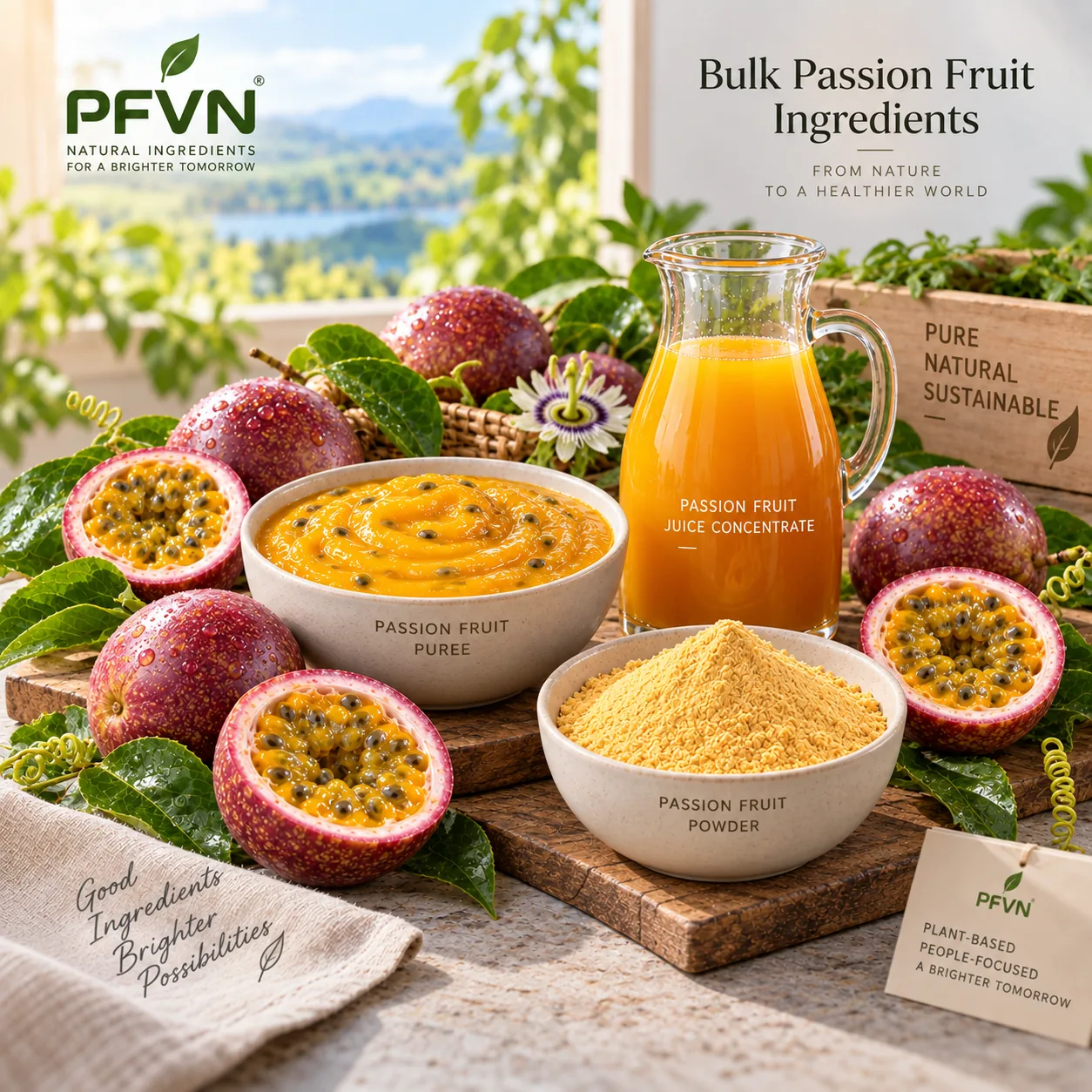
Passion fruit belongs to the genus Passiflora, with commercial fruit production centered largely on forms of Passiflora edulis. The fruit has a firm outer rind surrounding an aromatic yellow-orange pulp containing numerous edible seeds. Purple and yellow passion fruit types are both commercially important, although cultivar, growing region and maturity can influence flavor, acidity, color and juice yield.
The edible pulp is prized for its powerful tropical aroma and a characteristic balance of sweetness and pronounced acidity. Passion fruit is more acidic and aromatic than many mainstream fruits, allowing relatively modest inclusion levels to contribute noticeable flavor to multi-fruit beverages and formulated foods.
For concentrate production, juice or pulp is separated from the fruit and processed to remove part of the naturally occurring water. Concentration increases soluble solids while reducing shipping and storage volume. Industrial passion fruit juice concentrate is commonly supplied near 50° Brix, although the exact concentration, pulp content and processing style depend on the producer and intended application.
Commercial specifications vary with origin, fruit variety, crop, processing method and supplier. The figures below are useful reference points for conventional passion fruit concentrate programs, but the actual supplier specification and lot-specific Certificate of Analysis should control purchasing decisions.
Many industrial passion fruit juice concentrates are standardized at approximately 50° Brix, commonly with a tolerance near ±1–2° Brix. Buyers should specify whether direct or corrected Brix is required for approval.
Passion fruit concentrate has substantially higher titratable acidity than many common fruit concentrates. Commercial examples can fall broadly around 9–18% acidity expressed as citric acid, depending on origin and specification.
Commercial 50° Brix products frequently fall within a strongly acidic pH range. Exact pH should be confirmed because it affects flavor balance, formulation, processing and compatibility with other ingredients.
Some passion fruit concentrates retain substantial suspended fruit material while others are produced with reduced pulp or in clarified formats. Define pulp, turbidity or clarity requirements when they influence the finished product.
The concentrate should have full characteristic passion fruit flavor and aroma without fermented, scorched, caramelized or other undesirable notes. Sensory qualification is particularly important for premium beverage programs.
Industrial specifications generally establish limits for total aerobic count, yeast and mold as well as applicable pathogen requirements. Exact criteria and test methods should be agreed during supplier approval.
A typical 50° Brix passion fruit concentrate may correspond to single-strength juice around 14° Brix, although single-strength reference values and reconstitution ratios are product-specific. Commercial examples use approximately one part 50° Brix concentrate to slightly more than three parts water when reconstituting toward a 14° Brix juice basis.
The ingredient's strong natural acidity means formulation should not be based on Brix alone. Product developers normally evaluate the Brix-to-acid balance, finished pH, sweetness, aroma intensity and interaction with other fruits. Passion fruit is often blended with sweeter or lower-acid ingredients to achieve a balanced tropical profile.
Common blending partners include mango, pineapple, orange, guava, peach, pear, banana, coconut and other tropical or citrus ingredients. Passion fruit can provide acidity and aroma to these combinations without requiring it to represent the majority of the fruit portion.
Passion fruit concentrate is valued across food and beverage manufacturing because it can provide strong recognizable flavor, fruit solids and natural acidity at relatively efficient inclusion levels.
One of the primary industrial uses. Passion fruit concentrate is used in fruit juices, nectars, multi-fruit drinks, still beverages, smoothies and tropical beverage bases either as the principal fruit or as a high-impact blending component.
Its strong flavor and natural acidity suit functional beverages where passion fruit can help mask or balance the sensory impact of vitamins, minerals, botanical extracts or other functional ingredients.
Used in carbonated beverages, flavored waters, tropical mixers, mocktails, cocktails and ready-to-drink formulations requiring a bright aromatic profile.
Passion fruit concentrate is incorporated into yogurt preparations, dairy drinks and plant-based dairy alternatives. Formulators should account for its acidity when designing dairy systems.
The concentrated tropical flavor works well in sorbet, ice cream, frozen yogurt, gelato, popsicles and dessert sauces, frequently as part of a formulated fruit preparation.
Used in gummies, fruit jellies, chews and other confectionery where the combination of tartness and strong tropical aroma can provide a clearly differentiated flavor.
Applicable to pastry fillings, cake preparations, fruit layers, glazes, toppings and bakery inclusions when incorporated into a formulation designed for the required viscosity and processing conditions.
Passion fruit's fruit acidity and aroma are also used in gourmet sauces, salad dressings, marinades, chutney-style products and sweet-savory culinary preparations.
Passion fruit concentrate should be qualified according to both analytical and sensory performance. A concentrate meeting the required Brix can still differ substantially from another source in acidity, pulp level, color, aromatic intensity and finished-product flavor.
Industrial buyers should also establish acceptable country of origin, conventional or organic status, ingredient declaration, processing method, packaging format and storage requirement. Commercial passion fruit supply is available from several tropical producing regions, and differences in fruit variety and processing can influence the finished concentrate.
For larger manufacturing programs, annual volume, crop availability, minimum order quantity and lead time should be discussed early. Where continuity is critical, buyers may choose to qualify more than one crop origin or approved supplier specification.
Exact documentation varies by producer and program. Buyers should establish required technical, regulatory and certification documents before commercial qualification.
Normally defines Brix, acidity, pH, color, flavor, pulp or clarity, microbiological limits, packaging, storage conditions and shelf life.
Provides lot-specific analytical results against the supplier's release specification and supports incoming quality-control procedures.
Ingredient declaration, allergen statement, GMO status, country of origin and other regulatory documents can be requested as required by the customer's market.
Organic, kosher, halal and recognized food-safety certifications may be available depending on the selected producer and program.
Choose the passion fruit format according to desired fruit solids, flavor intensity, processing method, storage requirements and finished-product texture.
Industrial packaging should be selected according to annual usage, batch volume, concentrate viscosity, frozen or aseptic storage requirements, thawing procedures, pumping capability and production rate.
Commonly used for product development and lower-volume manufacturing. Frozen pail programs are available in the wider concentrate market, with exact fill weight depending on product density.
Frozen or aseptic bag-in-drum packaging is a common industrial format for passion fruit concentrate. Actual drum weight, liner system and pallet configuration vary by source.
IBC or tote supply may be suitable for high-throughput programs when supported by the concentrate specification, filling method and supplier's logistics program.
Selected suppliers can support tanker or other bulk liquid arrangements for large programs where storage, transport temperature and unloading systems are appropriate.
Include your application, target Brix, acidity or pulp requirements, certification needs, estimated quantity, packaging, delivery location and timing. These details help us identify the most suitable passion fruit concentrate program.