
Fruit content & ingredient declaration
Confirm tomatillo content and whether water, salt, acidulants or other permitted ingredients are included. Buyers should also specify conventional or organic status and any relevant origin requirements.
Bulk tomatillo puree is a tart, savory fruit ingredient widely suited to salsa verde, green sauces, dips, soups, culinary bases, ready meals and Mexican- or Latin-inspired prepared foods. It provides characteristic tomatillo acidity, green fruit flavor, natural solids and smooth body while reducing the need to husk, wash, cook and puree fresh tomatillos in-house.
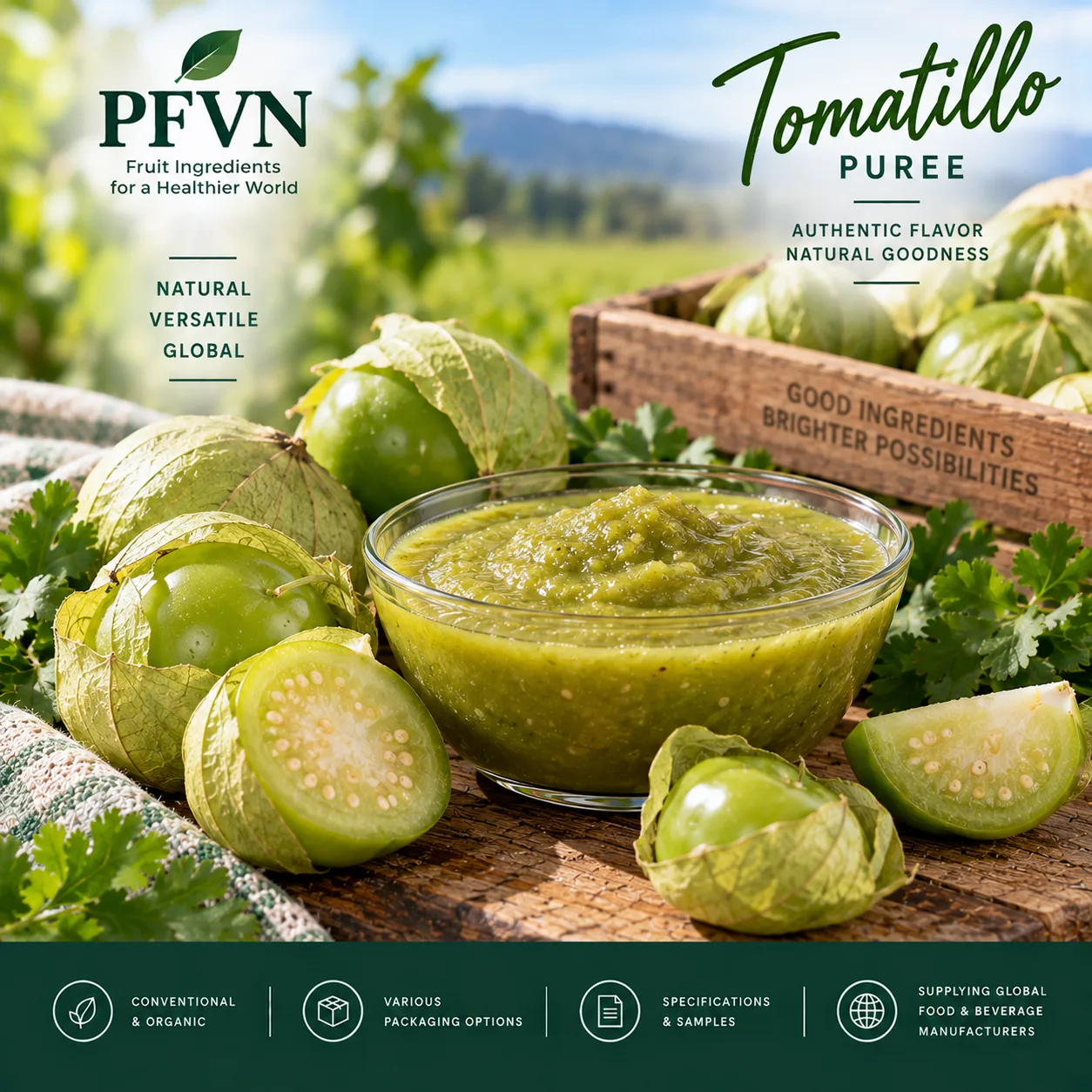
Tomatillo (Physalis philadelphica, also commonly associated with the name Physalis ixocarpa) is a member of the nightshade family and is botanically a fruit, although it is used primarily in savory foods. Each fruit develops inside a thin papery husk that is removed before processing.
Commercial tomatillos are most commonly green, although yellow-green and purple-fruited types also exist. The flesh is firm when fresh and contains numerous small edible seeds. Flavor is characteristically tart, fresh and slightly herbaceous, with sweetness and acidity changing as the fruit matures.
For industrial puree production, the husks are removed and the fruit is thoroughly washed to remove surface residue before sorting, cooking or blanching where required, pulping and refining. The resulting puree retains considerably more fruit solids and body than a clarified juice and can be tailored through the finishing process for smooth or more rustic applications.
Tomatillo puree should be qualified around acidity, soluble solids, color, particle size and consistency. Fruit maturity and thermal processing can noticeably change its fresh-green flavor, tartness and final sauce behavior.
Confirm tomatillo content and whether water, salt, acidulants or other permitted ingredients are included. Buyers should also specify conventional or organic status and any relevant origin requirements.
Commercial review may include soluble solids / °Brix, pH and titratable acidity. For tomatillo, acidity is particularly important because it strongly influences the characteristic tart flavor and the balance of finished salsas and sauces.
Tomatillo contains many small edible seeds. Milling and screening determine seed visibility, particle size and finished viscosity, so the puree finish should be matched to smooth sauces, dips or more rustic culinary products.
Commercial approval commonly considers green to olive-green color, characteristic tart tomatillo flavor, herbaceous notes, seed perception and the absence of fermented, scorched or excessively bitter flavors.
Tomatillos are valued for their natural tartness, but acidity and flavor intensity vary with fruit maturity. Less mature green fruit generally provides a sharper profile, while more mature fruit can develop softer acidity and increased sweetness. Manufacturers should therefore qualify the sensory profile as well as analytical values.
Heat treatment softens the fruit and changes its fresh, herbaceous character toward a more cooked flavor. It can also shift bright green appearance toward a more muted green or olive tone. Salsa and sauce manufacturers should evaluate the puree after the same cooking, pasteurization or retort conditions planned for the finished product.
The fruit's pulp and fine seeds can contribute useful natural body. Puree consistency may therefore reduce the amount of separate thickening required in some formulations, although actual performance depends on inclusion rate, particle size and the other ingredients in the recipe.
Tomatillo puree is primarily a savory ingredient and is particularly useful in products where manufacturers need the characteristic flavor and acidity of tomatillo in a consistent, pumpable format.
The primary industrial application for tomatillo puree. It provides the tart fruit base for salsa verde and green sauces combined with chili peppers, onion, garlic, cilantro and other seasonings.
Application guide → Dips & spreads Tomatillo dips & savory spreadsUsed in refrigerated and shelf-stable dips, avocado-tomatillo blends, creamy green sauces and vegetable spreads where acidity and smooth body are required.
Application guide → Soups & culinary Soups, stews & cooking basesSuitable for green chili soups, stews, braising sauces and culinary bases where tomatillo supplies tartness and recognizable Mexican or Southwestern flavor.
Application guide → Prepared foods Ready meals, enchiladas & entréesCan be incorporated into enchilada sauces, prepared rice and bean dishes, casseroles, frozen entrées and meal components requiring consistent tomatillo flavor.
Application guide → Plant-based foods Plant-based meals & savory formulationsWorks well in plant-based bowls, fillings, sauces and vegetable-forward meals combined with beans, grains, corn, peppers and plant proteins.
Application guide → Vegetable blends Specialty savory puree systemsWhere suitable for the product concept, mild tomatillo puree may be used at controlled levels in savory vegetable blends requiring smooth texture and balanced acidity.
Application guide →Tomatillo puree can be used in fillings for tamales, burritos, tacos and other prepared products where a smooth green sauce component is required. It pairs naturally with roasted peppers, jalapeño, poblano, onion, garlic, cilantro, lime and cumin.
It can also provide acidity and fruit body in marinades, cooking sauces, glazes and condiment bases. Manufacturers can adjust the inclusion level depending on whether tomatillo should be the dominant flavor or function as a supporting acidic component.
The most important commercial variables are usually acidity, maturity profile, puree finish and color. Tomatillo intended for a fresh-tasting refrigerated salsa may need a different sensory profile from puree used in a heavily cooked enchilada sauce or retorted prepared meal.
Seed and particle-size expectations should also be defined. Some salsa applications benefit from visible natural particles, while smooth sauces and high-speed filling systems may require a finer and more uniform finish.
Commercial planning should consider crop origin, conventional or organic status, annual volume, frozen or aseptic storage capability, package size, shipment frequency and delivery timing. Larger recurring programs benefit from agreed analytical, color and sensory tolerances.
Technical, agricultural and food-safety requirements should be reviewed for the exact tomatillo puree and producing facility being considered. Documentation requirements vary by buyer, application and destination market.
The specification commonly identifies composition, °Brix or solids, pH, acidity, viscosity, sieve / finish, seed profile, color, sensory criteria, microbiological limits, packaging and shelf life.
Where included in the supply program, lot documentation may report selected physical, chemical and microbiological results against the approved product specification.
Depending on buyer and destination requirements, documentation may include country-of-origin information and applicable pesticide-residue or agricultural compliance records.
Facility certification, allergen and GMO statements, traceability information and food-safety documentation may form part of the supplier-approval process.
Tomatillo puree is currently the only tomatillo ingredient format listed in the PFVN catalog. Additional format requirements can be included in the inquiry for sourcing review.
This is currently the only listed PFVN format for this ingredient.
Tomatillo puree may be supplied in frozen or aseptic formats depending on processor capability and product specification. Package selection should account for batch size, storage conditions, puree viscosity, thawing or pumping requirements, product turnover and unloading equipment.
Useful for product-development trials, pilot production and smaller manufacturing runs. Availability may be frozen or aseptic depending on the supply program.
A common industrial format for puree supply. Lined drums support palletized handling and may be used for frozen or aseptic tomatillo puree programs.
Potentially suitable for higher-volume manufacturing where puree consistency, filling technology and plant pumping equipment support bulk tote handling.
Selected tomatillo puree programs may use smaller bag-in-box, lined-carton or frozen block formats where easier portioning, thawing or lower batch consumption is preferred.
Include the application, target °Brix or solids, pH or acidity, seed and puree-finish requirements, desired color, quantity, packaging, delivery location and timing. These details help us evaluate the appropriate tomatillo puree supply program for your manufacturing requirements.