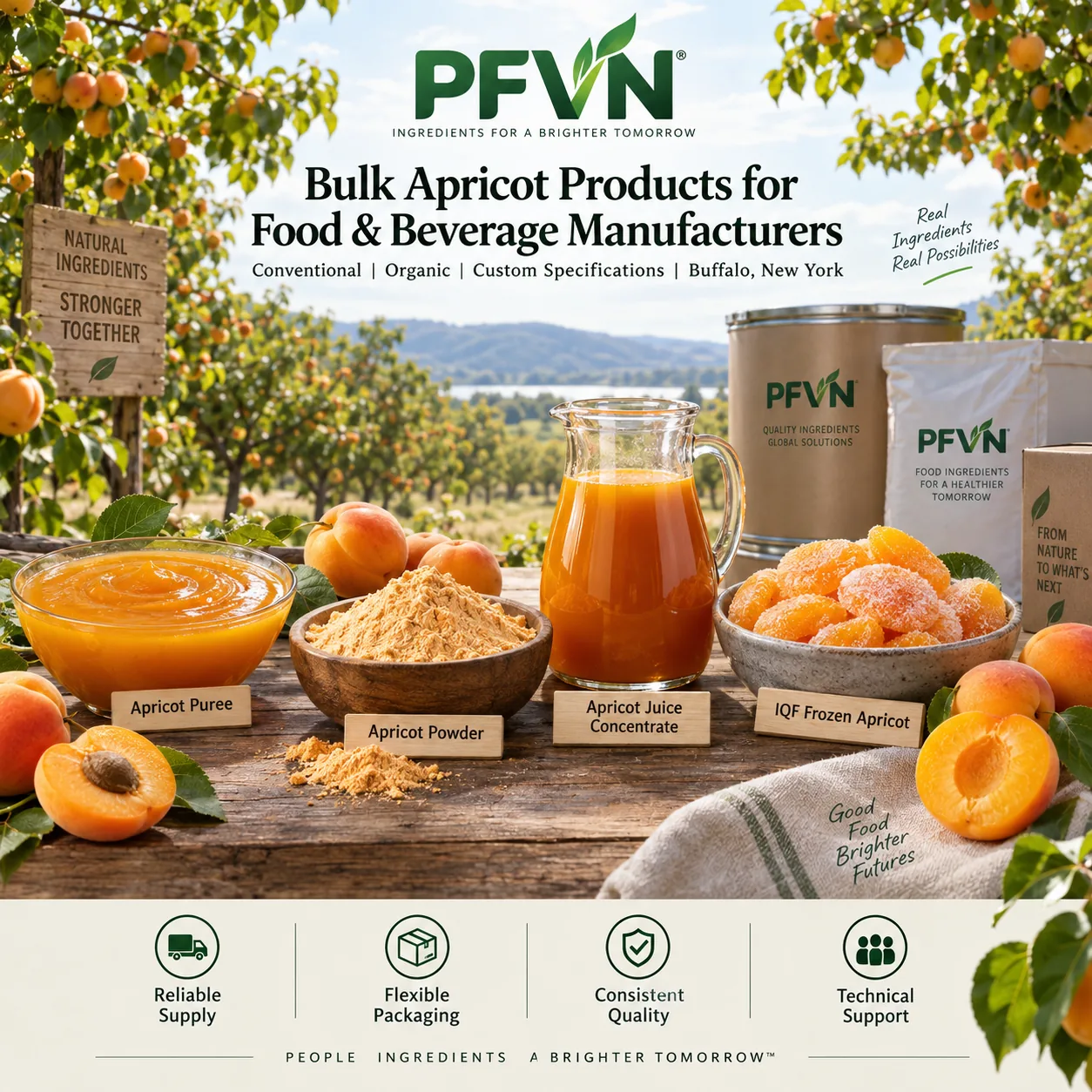
Apricot Puree · Bulk B2B Ingredient

Bulk Apricot Puree

Bulk apricot puree is a smooth stone-fruit ingredient used by food and beverage manufacturers for its characteristic apricot aroma, balanced sweetness and acidity, natural fruit solids and orange-gold color. It is suitable for beverages, baby food, yogurt preparations, bakery fillings, jams, frozen desserts, sauces and other fruit-based formulations. PFVN supports industrial buyers with conventional and organic programs, technical specifications, packaging, documentation and commercial supply options.

Bulk supply Conventional programs Organic options Aseptic or frozen options Single-strength & concentrated options Documentation on request
Bulk Apricot Puree for industrial food and beverage manufacturing
Fruit profile

Apricot characteristics that influence puree quality

Apricot, botanically Prunus armeniaca, is a stone fruit or drupe with soft orange-to-yellow flesh surrounding a hard central pit. Commercial puree is produced from mature fruit after sorting, washing and destoning, followed by crushing or milling and refining to obtain the required particle size and consistency.

Ripe apricots have a distinctive aromatic stone-fruit profile with a naturally sweet-tart balance. Variety, growing region and harvest maturity influence soluble solids, acidity, aroma, flesh color and natural pectin content, all of which can affect finished puree performance.

The orange-gold appearance of apricot flesh is associated with naturally occurring carotenoid pigments. Apricot also contains pectic and insoluble fruit materials that help give puree more body and opacity than clarified juice. These characteristics make puree particularly useful where manufacturers want recognizable fruit texture as well as flavor.

Raw-material note: Apricot is an agricultural ingredient. Variety, maturity, crop conditions, origin and processing can produce normal differences in °Brix, acidity, aroma, color and consistency. Critical attributes should therefore be defined in the purchasing specification.
Commercial formats

Single-strength and concentrated apricot puree

Apricot can be supplied in more than one solids range. Manufacturers should confirm whether a quotation refers to natural-strength puree or concentrated puree because the two formats differ materially in fruit-solids concentration, viscosity, freight economics and formulation requirements.

Technical specifications

Key parameters for apricot puree qualification

Technical approval normally considers soluble solids, acid profile, consistency, particle size, color, sensory characteristics, microbiological limits and process format. Exact values should be confirmed against the current product specification and representative sample.

Specification note: Reference values such as approximately 11.5°Brix minimum for single-strength aseptic puree, 31.5 ± 1.5°Brix for concentrate and pH 3.2–4.2 are useful qualification benchmarks, not guaranteed PFVN specifications. Confirm every critical parameter against the exact source being quoted.
Processing & fruit performance

Natural pectin and pulp give apricot puree useful body

Apricot puree behaves differently from clarified juice because it contains suspended fruit solids and natural pectic material. These components contribute viscosity, mouthfeel, opacity and water-binding behavior and can help build fruit texture in beverages, fillings and spoonable preparations.

Processing conditions can alter this natural structure. Mechanical refining, heat treatment and concentration may affect viscosity, while downstream formulation with sugars, starches, gums or other fruit ingredients can further change the finished consistency.

Manufacturers should evaluate pumpability, mixing, separation and texture under the actual production conditions of the intended product. Bakery fillings and fruit preparations may require substantially greater body than drinkable products or smoothie systems.

Major industrial applications

Where apricot puree is used

Apricot puree is valued for its aromatic stone-fruit profile, orange-gold appearance, natural acidity and substantial fruit body. Major applications include beverages, baby food, dairy preparations, bakery fillings, frozen desserts, jams, fruit spreads and dessert sauces.

Additional manufacturing uses

Apricot in sauces, confectionery and nutrition products

The balance of fruit aroma, acidity and natural body also makes apricot puree useful in adjacent applications where a smooth fruit component is preferred over whole or diced fruit.

Thermal processing & color

Evaluate color and flavor after processing

Apricot's orange color and aromatic profile can change during prolonged heat exposure, concentration and storage. Thermal processing is necessary for many commercial puree systems, but excessive process severity can reduce fresh-fruit aroma or produce darker cooked notes.

Oxidation can also influence color, particularly during processing or after opening. Depending on the commercial product, processors may use controlled processing conditions or permitted antioxidant systems to support color stability.

Manufacturers using apricot puree in pasteurized beverages, retorted products, bakery fillings or frozen products should evaluate the ingredient under the same heat, cooling and storage conditions expected in commercial production.

Commercial sourcing

Origin, crop and specification influence commercial equivalence

Apricot puree is available from multiple producing regions and processing programs. Variety, harvest maturity, climate and production method can influence fruit aroma, soluble solids, acidity and color, so products from different origins are not necessarily interchangeable even when they carry the same basic description.

For long-term programs, buyers may wish to qualify more than one acceptable origin or processor where technically practical. This can support continuity of supply when individual harvest seasons, crop volumes or production schedules change.

Commercial inquiries should identify whether the requirement is conventional or organic, single-strength or concentrated, aseptic or frozen, and whether origin restrictions apply. Trial quantity, annual demand and delivery schedule also help determine the appropriate source.

Packaging & storage

Aseptic and frozen apricot puree supply

Apricot puree can be supplied under aseptic or frozen programs depending on the processor and product specification. Buyers should match the format to their warehouse capacity, production batch size, inventory turnover and handling equipment.

Quality & microbiology

Establish acceptance criteria before ordering

Commercial specifications may define limits for aerobic plate count, yeast and mold, coliforms and relevant pathogens. Required microbiological criteria depend on the puree process, packaging, storage system and intended application.

Physical acceptance criteria may include color, consistency, foreign material, pit or pit-fragment absence, peel particles and other fruit defects. These parameters are particularly important in baby food, beverages and smooth dairy preparations.

Because apricot is an agricultural product, normal crop variation in soluble solids, acidity and color should be expected. Agreed commercial ranges allow manufacturers to control characteristics that materially affect the finished product without rejecting normal natural variation.

Same ingredient

Other Apricot formats

Depending on the formulation, apricot may also be sourced as IQF frozen fruit, juice concentrate or powder when a recognizable fruit piece, concentrated liquid or dry-format ingredient better suits the manufacturing process.

Packaging & handling

Commercial apricot puree packaging

Select packaging around batch volume, storage conditions, thawing or pumping requirements, line rate, inventory turnover and unloading equipment. Exact availability depends on the processor and commercial program.

Pilot / smaller batch

5-gallon or roughly 15–25 kg pails

Useful for product-development trials and smaller manufacturing runs. Commercial frozen apricot puree is commonly available in pail-scale formats, although exact fill weight and storage requirements vary by supplier.

Commercial drum

Roughly 180–225 kg bag-in-drum

A common industrial format for aseptic or frozen fruit puree. Commercial apricot programs frequently use aseptic liners within metal drums, with exact fill weights determined by the processor.

Tote / IBC

About 275 gallons / around 1,000 L

Potentially suitable for higher-volume pumpable programs where the product, processing system and filling technology support bulk tote supply. Availability should be confirmed for the specific source.

Smaller bulk / foodservice

Bag-in-box or block formats

Selected programs may use bag-in-box, lined-carton or frozen block configurations where smaller handling units or easier portioning are preferred.

Availability note: The formats shown above are common industrial reference points for fruit purees and are not a promise that every package is available from every apricot processor, origin or program. Confirm current net weight, liner, pallet pattern, storage condition, minimum order quantity and lead time in the quotation.
Request a quote

Tell us what your apricot puree program needs.

Include the application, single-strength or concentrated format, target °Brix, pH or acidity where critical, sieve or consistency requirement, certification, estimated quantity, packaging, delivery location and timing. These details help identify an appropriate commercial source and specification.

PFVN · Buffalo, New York
info@pfvn.us

We use your details only to respond to this inquiry.