Fruit & Vegetable Purees · Bulk B2B ingredients

Bulk Kale Puree

Bulk kale puree is a deep-green vegetable ingredient used by food manufacturers when a formulation requires recognizable leafy-green character, vegetable solids, color and smooth body without handling whole or chopped leaves. It is particularly suited to soups, sauces, baby food, prepared meals, plant-based products, dips and selected green beverage applications.

Bulk supply Conventional programs Organic options Frozen / aseptic options Documentation on request
Bulk Kale Puree
Vegetable profile

About kale and kale puree

Kale is a leafy member of Brassica oleracea grown for its dense green leaves rather than for a compact head. Commercial varieties can differ considerably in leaf shape, tenderness, stem thickness, green color and flavor intensity, ranging from relatively mild leafy profiles to more pronounced brassica character.

The leaves contain substantial insoluble plant material, so industrial processing must balance vegetable identity with the desired mouthfeel. The ratio of leaf to stem, harvest maturity and finishing conditions can all influence fiber perception, viscosity and flavor in the finished puree.

Kale puree is generally produced from cleaned and sorted leaves that may be trimmed, blanched or otherwise heat-treated before size reduction and refining. The finished material can range from finely homogenized and smooth to a slightly more textured puree depending on the screen, milling system and intended application.

Technical & commercial profile

Key specification points for industrial kale puree

Kale puree should be qualified around color, texture, vegetable solids and processing behavior. Unlike sweet fruit purees, soluble solids alone do not describe product performance, so buyers should place particular emphasis on puree finish, viscosity, leaf composition and sensory character.

Composition

Leaf content & ingredient declaration

Confirm whether the product is 100% kale or includes water or other permitted ingredients, and whether the processing specification defines leaf and stem handling. Conventional and organic supply should be identified at the RFQ stage.

Physical & chemical

Solids, pH & consistency

Qualification may include total or soluble solids, pH, viscosity or consistency and density where relevant. These parameters help manufacturers understand dosing, pumping and finished-product body.

Texture

Particle size & fiber profile

Sieve, screen or homogenization conditions influence leaf-particle size and fibrous mouthfeel. Fine finishes may be preferred for baby food and smooth sauces, while prepared foods can tolerate more visible vegetable texture.

Sensory

Green color & vegetable flavor

Commercial approval should consider green color intensity, leafy aroma, bitterness, brassica character, cooked notes and overall consistency with the agreed sensory reference.

Specification note: solids, pH, viscosity, particle size, color, microbiological limits, storage conditions and shelf life vary with raw material, process and supplier. PFVN confirms these values against the current product specification rather than publishing one universal kale puree specification.
Processing & functionality

Color, texture and process considerations

The green appearance of kale is associated primarily with chlorophyll pigments. Heat, acidity, oxygen exposure and storage can alter the visual profile of green vegetable ingredients, so manufacturers with strict color targets should evaluate the puree after the actual thermal process used in the finished product.

Blanching or other heat treatment may be used during industrial processing to soften leaf structure, reduce enzyme activity and prepare the vegetable for further processing. The exact treatment affects flavor, color and texture and should therefore be considered when comparing samples from different sources.

Kale puree is also more fibrous than many fruit purees. Pump selection, line diameter, homogenization, depositing equipment and screen size can affect plant performance. For smooth products, buyers should establish a clear particle-size or sieve requirement before commercial approval.

Industrial applications

Major uses for bulk kale puree

Kale puree is primarily used in savory and vegetable-forward products where manufacturers need controlled leafy-green flavor, natural green color and consistent vegetable solids without the variability of handling fresh leaves.

Additional applications

Green beverages and blended vegetable systems

Finely processed kale puree can also be used in smoothies, vegetable beverages and green drink bases when manufacturers want more whole-vegetable character than a clarified juice provides. It is commonly balanced with apple, pear, pineapple, citrus or other ingredients that moderate kale's stronger leafy and brassica notes.

In blended vegetable systems, kale may be combined with spinach, broccoli, carrot, celery or other vegetables to build color and flavor complexity. Because puree retains more insoluble material than juice, sedimentation, suspension and mouthfeel should be evaluated during formulation.

Commercial purchasing

Qualifying kale puree for production

The most suitable kale puree depends strongly on the manufacturing process. Baby food and beverage applications generally require tighter particle-size control, while soups, sauces and prepared meals may accept a heavier texture and stronger leafy character.

Color should also be qualified in the actual product rather than only in the incoming puree. Heating, formulation pH and storage conditions may alter green vegetable color, and these effects can differ between production processes.

Commercial planning should consider crop origin, conventional or organic status, harvest availability, annual volume, frozen or aseptic storage capacity, package size and delivery schedule. Repeat programs benefit from defined sensory and physical tolerances to reduce lot-to-lot variation.

Quality & documentation

Common commercial approval points

Vegetable puree programs typically require review of both product-level specifications and supplier documentation. Requirements vary by application, customer and destination market and should be confirmed for the actual producing facility.

Technical

Product specification

The specification commonly identifies composition, solids, pH, consistency, particle size or finish, sensory criteria, microbiological limits, packaging, storage conditions and shelf life.

Lot control

Certificate of analysis

Where included in the supply program, lot documentation may report selected physical, chemical and microbiological results against the approved specification.

Agricultural compliance

Residue & origin requirements

Depending on the customer and destination market, buyers may require country-of-origin information and applicable pesticide-residue or other agricultural compliance documentation.

Supplier approval

Food-safety documentation

Facility certification, allergen and GMO statements, traceability information and food-safety documentation may form part of the supplier-approval process.

Same ingredient

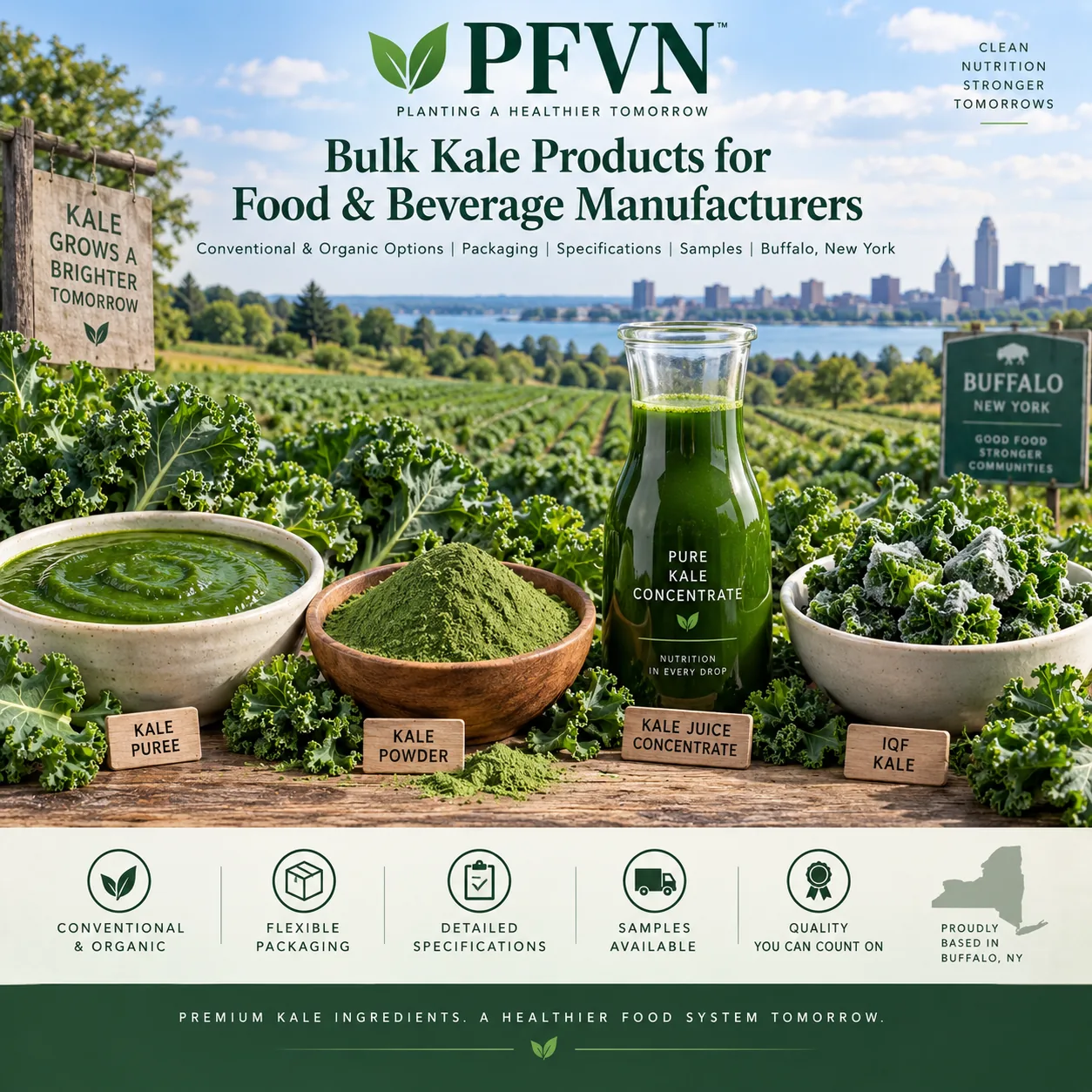
Other Kale formats

Select the kale format according to whether the formulation requires intact leaf structure, complete puree body, a concentrated liquid vegetable ingredient or a low-moisture powder.

Packaging & handling

Industrial kale puree packaging

Kale puree may be supplied in frozen or aseptic formats depending on processor capability and product specification. Package selection should consider batch size, storage temperature, thawing or handling requirements, puree viscosity, line rate and unloading equipment.

Pilot / smaller batch

5-gallon or roughly 15–25 kg pails

Useful for product-development trials, pilot runs and smaller manufacturing programs. Availability may be frozen or aseptic depending on the supplier.

Commercial drum

Roughly 180–225 kg bag-in-drum

A common industrial scale for vegetable puree supply. Lined drums support palletized handling and can suit frozen or aseptic programs where available.

Tote / IBC

About 275 gallons / around 1,000 L

Potentially suitable for higher-volume production where puree viscosity, filling technology and plant pumping equipment support bulk tote handling.

Smaller bulk / portioning

Bag-in-box or block formats

Selected vegetable puree programs may use smaller bag-in-box, lined-carton or frozen block formats for easier portioning, thawing and lower batch consumption.

Availability note: The formats shown above are common industrial reference points rather than guaranteed pack sizes for every kale puree source. Confirm current net weight, liner type, pallet configuration, storage condition, shelf life, minimum order quantity and lead time in the quotation.
Request a quote

Tell us what your kale program needs.

Include the application, required puree finish or particle size, quantity, preferred packaging, delivery location and target timing. These details help us evaluate the appropriate kale puree supply program for your manufacturing requirements.

PFVN · Buffalo, New York
info@pfvn.us

We use your details only to respond to this inquiry.