Fruit & Vegetable Purees · Bulk B2B ingredients

Bulk Aronia Puree

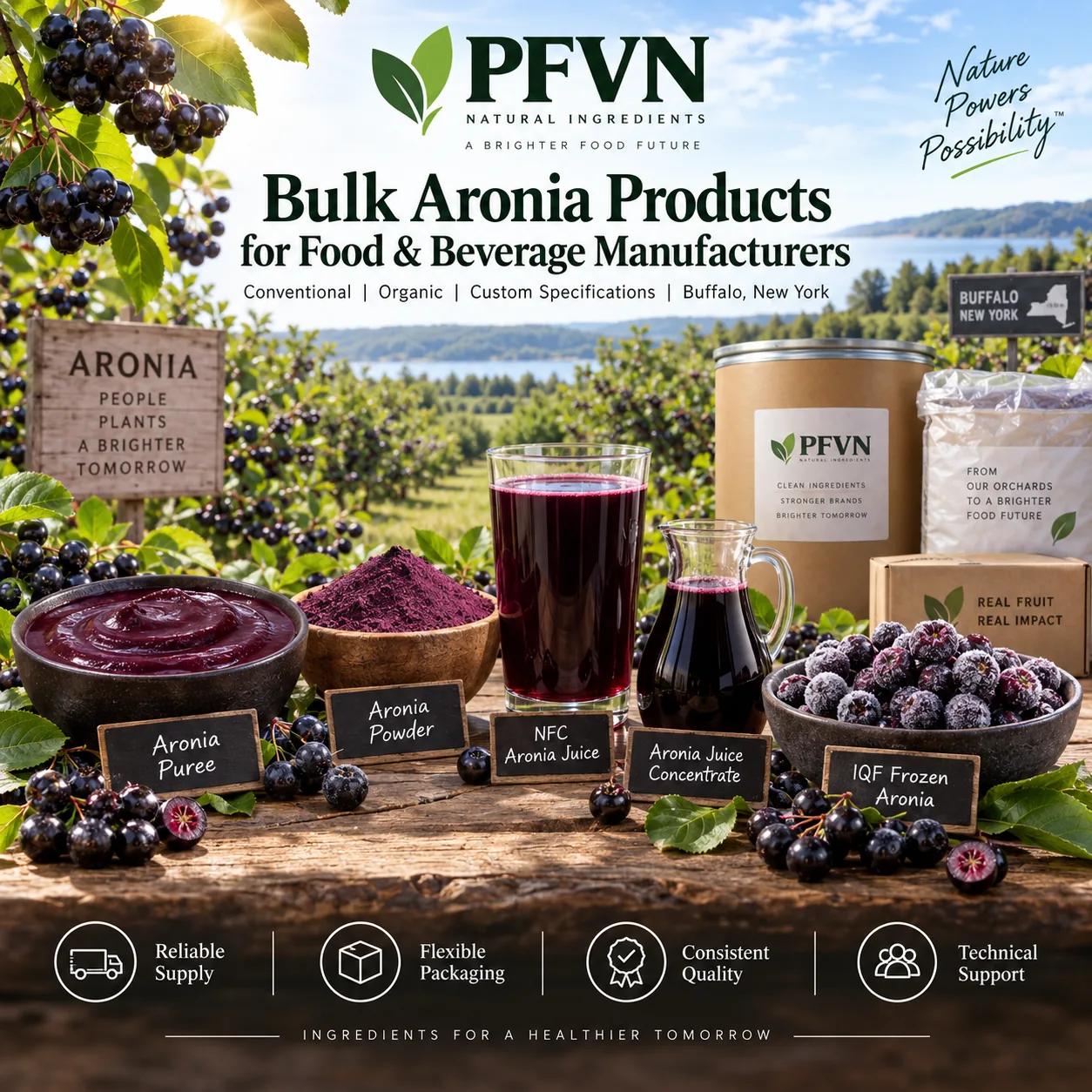
Bulk aronia puree is a dark red-purple berry ingredient valued for its intense color, tart flavor, pronounced astringency and whole-fruit body. It is used in beverages, smoothies, dairy fruit preparations, bakery fillings, frozen desserts, fruit spreads, sauces and specialty berry blends where manufacturers need strong aronia character together with pulp and fruit solids.

Bulk supply Dark berry ingredient Conventional & organic options Aseptic / frozen options Documentation on request
Bulk Aronia Puree
Ingredient profile

About aronia berries and aronia puree

Aronia, commonly known as chokeberry, is a small dark berry from the genus Aronia. Black chokeberry, Aronia melanocarpa, is the type most commonly associated with commercial food processing. Mature berries develop a deep purple-black skin and dark red-purple juice and pulp.

Aronia has a distinctive sensory profile. The berries combine fruit acidity with relatively low perceived sweetness and noticeable astringency. This drying mouthfeel is associated with naturally occurring polyphenolic compounds, which also contribute to aronia's intense color and make the fruit particularly useful in strongly flavored berry blends.

For puree production, berries are normally cleaned, sorted, crushed or pulped and refined to the required finish. Unlike clarified juice, puree retains more of the fruit's insoluble material, including fine skin and pulp fractions, which can increase body, color intensity and astringency.

Technical & commercial profile

Key specification points for industrial aronia puree

Aronia puree should be qualified around soluble solids, acidity, astringency, color, particle profile and consistency. Because the fruit is naturally intense, sensory approval and blending trials can be as important as the analytical specification.

Physical & chemical

°Brix, pH & titratable acidity

Commercial specifications commonly include soluble solids / °Brix, pH and titratable acidity. These values help formulators understand sweetness, tartness and how the puree will balance with sweeter juices, purees or added sugars.

Texture

Sieve, particle size & viscosity

The level of finely divided skin and pulp affects viscosity, mouthfeel and visual appearance. Buyers should define the required sieve / finish and evaluate whether the puree is intended for smooth beverages or heavier fruit preparations.

Color

Deep anthocyanin-related pigmentation

Aronia is valued for its naturally dark red-purple pigmentation. Color should be evaluated both in the incoming puree and in the finished formulation because pH, heat, oxygen, light and storage conditions can influence appearance.

Sensory

Tartness & astringency

Commercial approval should consider characteristic aronia flavor, acidity and drying astringency together with the absence of fermented, oxidized, moldy or excessively cooked notes.

Specification note: °Brix, pH, titratable acidity, viscosity, sieve / finish, color, microbiological limits, storage conditions and shelf life vary by crop, origin and processing method. PFVN confirms these values against the current supplier specification rather than publishing one universal aronia puree specification.
Processing & functionality

Color, astringency and formulation behavior

Aronia's dark color is one of its most commercially distinctive properties. The pigment system is naturally sensitive to formulation conditions, so color should be evaluated after pasteurization, concentration, freezing, storage or other processing steps used in the finished product.

The fruit's natural astringency is equally important. Aronia is rarely selected solely for sweetness; instead, formulators frequently balance it with sweeter or milder fruits such as apple, pear, grape, blueberry, strawberry or cherry. Sweeteners and other formulation components may also be used to moderate the drying finish.

Because puree retains skin and pulp material, settling and suspension behavior should be reviewed in beverages. Homogenization, stabilizer systems and the chosen particle size can influence final mouthfeel and visual stability.

Industrial applications

Major uses for bulk aronia puree

Aronia puree is most effective where its strong berry character and dark color are desirable. In many formulations it is blended with sweeter fruits rather than used as the only fruit component.

Additional applications

Sauces, confectionery & specialty berry systems

Aronia puree can be incorporated into dessert sauces, toppings, confectionery fillings and fruit gels where strong color and tart berry character are desirable. It pairs naturally with chocolate, vanilla, cherry and other dark-fruit flavors.

In savory applications, small amounts can be used in berry sauces, glazes, chutneys and sweet-savory condiments, particularly alongside game-style flavor profiles, roasted ingredients or warm spices. The use level should be adjusted carefully because aronia's astringency can become dominant.

Commercial purchasing

Qualifying aronia puree for production

Commercial approval should consider more than °Brix and acidity. Aronia's color intensity, astringency and skin-derived texture can vary by crop, maturity and processing conditions, so representative samples are particularly useful when the fruit is a prominent part of the finished flavor profile.

Manufacturers should define whether a very fine puree is needed or whether a heavier whole-fruit character is acceptable. Beverage producers may prioritize smoothness and suspension, while fillings and spreads may benefit from greater body.

Commercial planning should also consider origin, crop season, conventional or organic status, annual usage, packaging format, frozen or ambient storage capability and delivery timing. Recurring programs benefit from agreed analytical, color and sensory tolerances.

Quality & documentation

Common commercial approval documents

Technical and compliance requirements vary according to buyer, application and destination market. Documentation should be confirmed for the specific aronia puree and producing facility being considered.

Technical

Product specification

The specification commonly identifies composition, °Brix, pH, acidity, viscosity, sieve / finish, color and sensory criteria, microbiological limits, packaging, storage requirements and shelf life.

Lot control

Certificate of analysis

Where included in the supply program, lot documentation may report selected physical, chemical and microbiological results against the approved product specification.

Compliance

Ingredient & program statements

Depending on customer requirements, documentation may include ingredient, allergen, GMO, country-of-origin, traceability and organic certification information where applicable.

Supplier approval

Food-safety documentation

Facility certification, quality-system information and food-safety documentation may be requested as part of supplier qualification and should be confirmed for the relevant processor.

Same ingredient

Other Aronia formats

Select the aronia format according to whether the manufacturing process requires intact frozen berries, complete puree body, single-strength juice, concentrated soluble solids or a low-moisture dry ingredient.

Packaging & handling

Industrial aronia puree packaging

Aronia puree may be supplied in aseptic or frozen formats depending on processor capability and product specification. Package selection should account for batch size, storage conditions, puree viscosity, thawing or pumping requirements, product turnover and production-line configuration.

Pilot / smaller batch

5-gallon or roughly 15–25 kg pails

Useful for laboratory trials, product development, pilot production and smaller manufacturing runs. Availability may be frozen or aseptic depending on the supply program.

Commercial drum

Roughly 180–225 kg bag-in-drum

A common industrial format for fruit puree supply. Lined drums support palletized handling and may be used for aseptic or frozen aronia puree programs.

Tote / IBC

About 275 gallons / around 1,000 L

Potentially suitable for higher-volume manufacturing where product viscosity, processor filling capability and plant pumping equipment support bulk tote handling.

Smaller bulk / foodservice

Bag-in-box or block formats

Selected aronia puree programs may use smaller bag-in-box, lined-carton or frozen block formats where easier portioning, thawing or lower batch consumption is preferred.

Availability note: The formats shown above are common industrial reference points rather than guaranteed packaging options for every aronia puree source. Confirm current net weight, liner type, pallet configuration, storage temperature, shelf life, minimum order quantity and lead time in the quotation.
Request a quote

Tell us what your aronia program needs.

Include the application, target °Brix or solids, pH or acidity, desired color, sieve or texture requirement, quantity, packaging, delivery location and timing. These details help us evaluate the appropriate aronia puree supply program for your manufacturing requirements.

PFVN · Buffalo, New York
info@pfvn.us

We use your details only to respond to this inquiry.