
5-gallon or roughly 15–25 kg pails
Useful for product-development trials and smaller manufacturing runs. Selected programs may also use approximately 20–25 kg aseptic bag-in-box formats for easier portioning.
Bulk banana puree is a smooth, naturally sweet fruit ingredient used by food and beverage manufacturers for characteristic ripe-banana flavor, substantial fruit solids, creamy body and viscosity. Major uses include smoothies, beverages, baby food, yogurt preparations, bakery, frozen desserts, confectionery and nutrition products. PFVN supports industrial buyers with conventional and organic sourcing programs, technical specifications, packaging, documentation and commercial supply options.
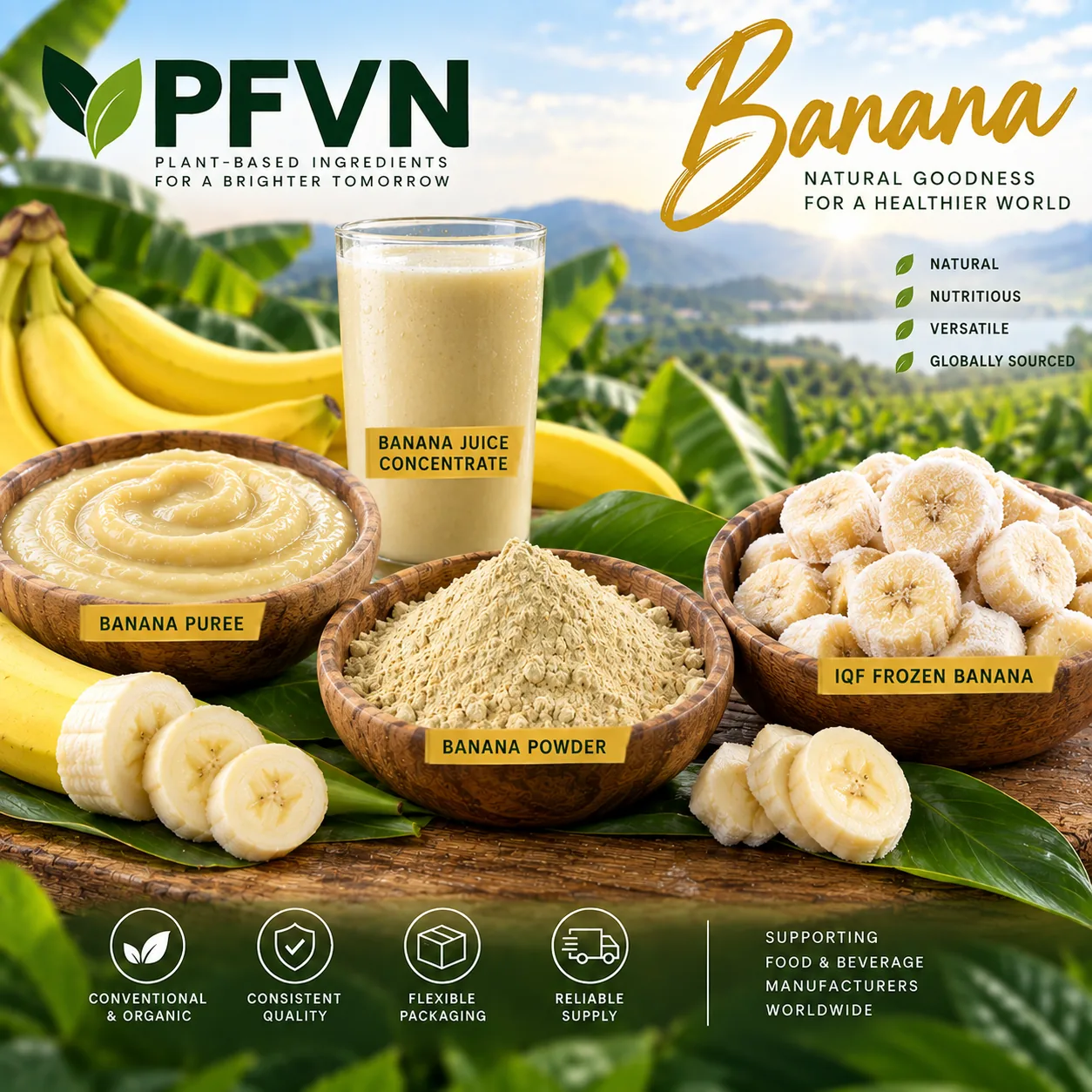
Commercial banana puree is commonly produced from ripe dessert bananas, particularly Cavendish-type cultivars. Bananas are climacteric fruits, meaning that major compositional changes continue during ripening after harvest. Starch in less-ripe fruit is progressively converted into sugars while the flesh softens and characteristic banana aroma develops.
For industrial puree, controlled ripening is therefore important. Fruit that is insufficiently ripe can produce a starchier, less aromatic puree, while overripe fruit can create darker color, softer consistency and a stronger fermented or overripe sensory profile if handling is not carefully controlled.
Ripe banana flesh is naturally creamy and contains substantial suspended fruit solids. Unlike clarified fruit juice, puree contributes viscosity and mouthfeel as well as sweetness and flavor, which makes banana particularly valuable in smoothies, dairy systems, desserts and fruit blends.
Commercial banana puree is available under different processing systems. One important distinction is whether the puree is acidified for processing and color stability or supplied as a non-acidified product retaining a pH closer to the natural fruit.
Citric acid and, in some programs, ascorbic acid may be used to lower pH and help manage browning and processing stability. Commercial acidified products commonly specify approximately 20°Brix minimum with pH at or below about 4.5.
Non-acidified puree may retain a pH closer to naturally ripe banana. Published commercial examples show approximately 21–26°Brix and pH around 4.5–5.0, although actual values vary with fruit and processor.
Acidification can influence tartness as well as process conditions. Buyers should therefore specify whether added citric or ascorbic acid is acceptable and evaluate the puree in the actual finished formulation.
When comparing suppliers, confirm acidification status, °Brix, pH, consistency and ingredient declaration. Two products sold as banana puree may perform differently if their fruit maturity or processing systems differ.
There is no single universal banana-puree specification. Industrial buyers typically evaluate soluble solids, pH, acidity, consistency, finish, color, sensory profile and microbiological criteria together before approving a commercial source.
°Brix is a useful indicator of soluble-solids concentration and fruit maturity. Commercial acidified Cavendish puree programs often specify at least about 20°Brix, while non-acidified programs may commonly fall in the low-to-mid 20s depending on cultivar and ripeness.
Acidified commercial products may be specified below approximately pH 4.5, while non-acidified examples may run closer to pH 4.5–5.0. Titratable acidity is also useful for comparing acidified products and evaluating flavor balance.
Banana puree naturally has substantial body. Published acidified commercial specifications commonly show Bostwick values around 5–15 cm per 30 seconds. Test temperature and method should be matched when comparing suppliers.
Commercial puree should generally be smooth and homogeneous without objectionable fibers or hard particles. Sieve or finishing requirements become particularly important for beverages, baby foods and products using narrow filling equipment.
Typical puree ranges from creamy white to pale or golden yellow depending on fruit maturity and processing. Brown or black specks may be controlled by specification where visual appearance is important.
Qualification should confirm clean, characteristic ripe-banana flavor without green, fermented, oxidized, scorched or other undesirable notes. Ripeness is a major contributor to final aroma quality.
Commercial aseptic specifications may establish very low limits for aerobic plate count, yeast and mold together with absence requirements for indicator organisms or relevant pathogens.
Buyers should confirm whether the puree is 100% banana or contains citric acid, ascorbic acid or other permitted processing ingredients. This distinction can affect formulation, labeling and product positioning.
One of the principal technical challenges in banana-puree manufacturing is rapid enzymatic browning after the fruit is peeled and the flesh is exposed to oxygen. Polyphenol oxidase activity can quickly shift the puree from pale cream toward brown if processing conditions are not controlled.
Commercial processing may use combinations of rapid fruit handling, heat treatment, deaeration, acidification, ascorbic acid and controlled packaging to reduce browning and protect sensory quality. The exact approach depends on whether the puree is acidified, non-acidified, aseptic or frozen.
Manufacturers should also evaluate color after their own production process. Additional heat, oxygen incorporation or prolonged storage can affect both banana color and aroma even when the incoming puree meets specification.
Banana puree is one of the most versatile fruit bases for products requiring natural sweetness, creamy texture, viscosity and recognizable fruit flavor. Its ability to add both flavor and body makes it useful across beverage, dairy, baby-food, bakery and frozen-dessert manufacturing.
A major industrial use for banana puree. It provides body, natural sweetness and a creamy mouthfeel to smoothies, shakes, fruit beverages and meal-replacement drinks while blending readily with berries and tropical fruits.
Application guide → Infant foods Baby Food ManufacturingFine, homogeneous banana puree is widely suited to single-fruit and blended baby-food formulations where smooth texture, fruit maturity, microbiological criteria and ingredient composition are carefully controlled.
Application guide → Dairy Fruit Preparations for YogurtBanana puree can provide fruit flavor, sweetness and body in yogurt preparations, dairy desserts, flavored milks and plant-based alternatives. Browning control and flavor stability are important qualification points.
Application guide → Bakery Bakery Fillings & InclusionsPuree can be incorporated into cake systems, muffins, breads, fillings and fruit layers where it contributes moisture, banana flavor and fruit solids.
Application guide → Frozen desserts Frozen Dessert ManufacturingBanana puree is used in ice cream, frozen yogurt, sorbet, smoothie bowls and other frozen desserts where its natural viscosity helps create a creamy fruit profile.
Application guide → Fruit preparations Jams, Spreads & Fruit PreparationsBanana puree can provide sweetness and body in tropical spreads and blended fruit preparations, often in combination with more acidic fruits to create the desired flavor and processing profile.
Application guide →Banana's mild sweetness and thick texture also support applications beyond traditional fruit beverages and desserts.
Puree can provide fruit flavor, natural sweetness and viscosity in nutrition shakes, smoothie systems and other formulated products requiring a substantial fruit base.
Banana puree can be incorporated into confectionery fillings, fruit centers and dessert preparations where its distinctive aroma pairs with chocolate, caramel, vanilla and nut flavors.
Puree can provide banana identity to porridge, oatmeal preparations, breakfast cups and other cereal-based products while contributing moisture and fruit solids.
Banana combines especially well with strawberry, mango, pineapple, passion fruit, blueberry, peach and apple and is often used to increase body and soften the acidity of blended fruit systems.
Banana puree should not be compared solely on price per kilogram. Fruit maturity, cultivar, °Brix, pH, acidification, consistency, color and processing method can materially change how the ingredient performs in a finished product.
Cavendish is widely used in industrial puree production because of its availability and processing characteristics, but source region and ripening program still influence flavor and physical properties. Buyers should also confirm whether added citric or ascorbic acid is permitted in their formulation.
Commercial inquiries should specify conventional or organic requirements, desired pack format, sample or trial quantity, annual demand, delivery destination and timing. Larger annual programs may also benefit from discussing forecast and contract requirements ahead of the intended shipment period.
Microbiological specifications depend on the processing method, package system and intended application. Aseptic commercial programs commonly establish tight limits for total plate count, yeast and mold together with requirements for indicator organisms and relevant pathogens.
Physical quality criteria can include consistency, fibers, seeds, brown specks, black specks, foreign material and color. These attributes become particularly important in visually light-colored foods, baby products and smooth beverage systems.
Natural variation between crops and ripening lots should be expected, but commercial ranges for °Brix, pH, consistency and color help maintain predictable manufacturing performance.
Commercial banana puree is widely available in aseptic packaging, with frozen formats also used in selected programs. The appropriate format depends on storage infrastructure, expected inventory turnover, package size and the manufacturer's production system.
Thermally processed puree packed in sterile barrier bags can support unopened ambient storage when allowed by the supplier specification. Commercial shelf life commonly ranges around one year or longer depending on product and storage temperature.
Frozen puree requires an uninterrupted cold chain and can be useful where manufacturers prefer frozen inventory. Storage temperature, thawing instructions and post-thaw life should follow the exact supplier specification.
Receiving teams may verify lot identity, package integrity, net weight, product condition, temperature where applicable and required documentation before releasing product to production.
Because banana puree is relatively viscous, drum unloading and pumping equipment should be matched to the product consistency and batch size. Smaller packs may be more practical for pilot or intermittent production.
Banana has a strong effect on texture because of its fruit solids and natural viscosity. A relatively modest addition can noticeably change beverage thickness, spoonability or filling behavior, particularly when combined with starch, protein, gums or other purees.
Manufacturers should also evaluate banana aroma and color after heat processing and storage. Dairy systems, frozen products and bakery applications can each affect perceived flavor differently, so incoming-puree sensory quality alone does not guarantee finished-product performance.
Depending on the application, banana may also be sourced as IQF frozen fruit, juice concentrate or powder when a recognizable fruit piece, concentrated liquid or dry-format ingredient better suits the manufacturing process.
Select package size around batch volume, storage conditions, pumping requirements, line rate and inventory turnover. Banana puree's viscosity should be considered when planning drum unloading or tote handling.
Useful for product-development trials and smaller manufacturing runs. Selected programs may also use approximately 20–25 kg aseptic bag-in-box formats for easier portioning.
A common commercial format for aseptic banana puree. Published supplier programs include approximately 215 kg and 230 kg net-weight drums, although exact fill weight and liner configuration vary by source.
Potentially suitable for high-volume, pumpable programs where product consistency and the supplier's filling system support bulk tote supply. Availability should be confirmed for the specific source.
Selected banana puree programs may use smaller aseptic bag-in-box, pail or frozen block formats where controlled portioning or lower production volumes make drum supply less practical.
Include the application, acidified or non-acidified preference, target °Brix, pH, consistency or Bostwick requirement, color expectations, conventional or organic program, estimated quantity, packaging, delivery location and timing. These details help identify an appropriate commercial source and specification.