
5-gallon or roughly 15–25 kg pails
Useful for product-development trials and smaller manufacturing runs. Depending on the program, pails may be frozen or supplied under another validated preservation system.
Bulk sweet potato puree is a smooth vegetable ingredient used by industrial food manufacturers for natural sweetness, substantial vegetable solids, creamy body and characteristic sweet potato flavor. Orange-fleshed varieties also provide a strong orange appearance associated with naturally occurring carotenoids. Applications include soups, sauces, baby food, bakery, plant-based foods, prepared meals, fillings and specialty formulations.
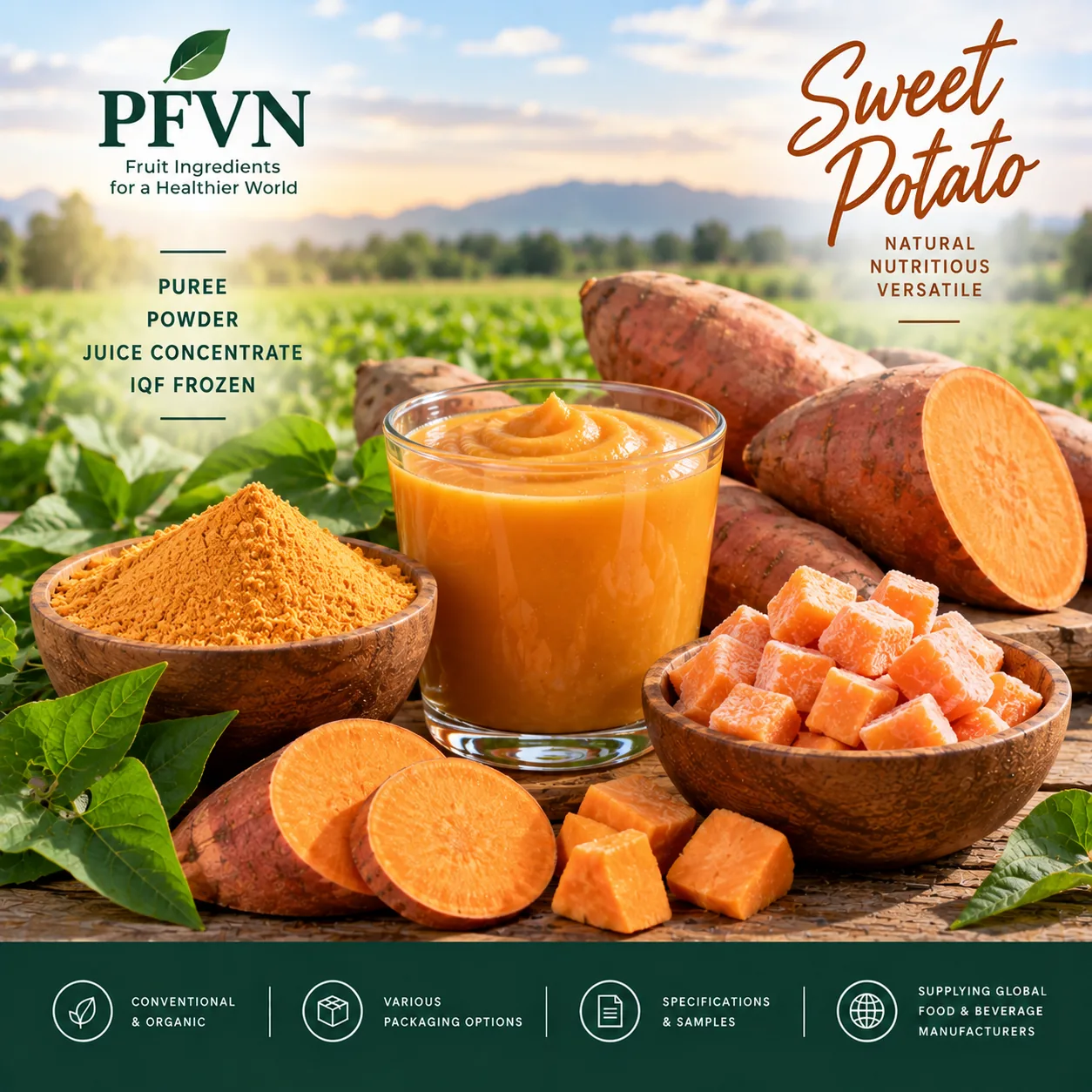
Sweet potato, botanically Ipomoea batatas, is a storage root rather than a true potato tuber. Commercial cultivars vary considerably in skin color, flesh color, dry matter, starch, natural sugars and texture. Flesh may be white, cream, yellow, orange or purple depending on the cultivar.
Orange-fleshed sweet potatoes are particularly useful in industrial puree applications because they combine starch and fiber with naturally occurring carotenoid pigments, including beta-carotene, which contribute their characteristic orange color. Cream- or yellow-fleshed varieties can provide a lighter appearance and somewhat different flavor and solids profile.
For puree manufacturing, roots are generally washed, sorted, peeled, cooked or thermally softened, milled and refined before preservation and packaging. Cooking softens the root structure and gelatinizes starch, helping create the smooth, dense consistency associated with commercial sweet potato puree.
Sweet potato puree allows manufacturers to incorporate cooked sweet potato without handling, peeling, trimming, cooking and milling whole roots at the production facility. It can provide consistent vegetable distribution, natural sweetness and substantial body across both savory and sweet formulations.
Cooked sweet potato contributes starch, fiber and suspended vegetable material that can add thickness and creamy mouthfeel to soups, sauces, fillings and prepared foods.
Sweet potato has a mild earthy-sweet profile that works in savory dishes, bakery products, baby foods and formulations where sweetness from the vegetable itself is desirable.
Orange-fleshed cultivars can provide a strong orange-gold appearance without requiring a separate vegetable-color component. Color intensity still varies with cultivar and process.
Puree can simplify handling compared with raw roots and provide more uniform metering into industrial mixers, kettles, filling systems and continuous production lines.
Exact specifications vary according to cultivar, solids level, processing method and supplier. Buyers should evaluate chemical, physical, sensory and microbiological characteristics together when qualifying a commercial source.
°Brix provides one indication of soluble solids, while total solids more broadly reflect the concentration of vegetable matter. A published commercial aseptic sweet potato puree specification lists ≥8°Brix as one reference point; other products may differ significantly.
Sweet potato is a low-acid vegetable ingredient rather than a naturally high-acid fruit puree. One commercial aseptic specification lists pH ≤5.4. The actual pH must be considered together with the supplier's validated thermal process and package system.
Screen size influences smoothness and retained fiber. As a commercial reference, one aseptic puree specification uses approximately 0.6–1.0 mm screening. Baby food and smooth sauces may require a finer controlled finish.
Sweet potato puree is naturally viscous because of starch and vegetable solids. One commercial reference specifies a Bostwick flow of approximately 5–9 cm per 30 seconds. Test method and temperature should be standardized when comparing suppliers.
Orange-fleshed puree should have a characteristic orange to orange-gold appearance, while yellow or cream varieties produce lighter puree. Excessive browning or unusual discoloration should be evaluated during qualification.
Commercial puree should provide clean, cooked sweet potato character with mild sweetness and without fermented, scorched, oxidized or other objectionable flavor notes.
Specifications may establish limits for total aerobic count, yeast and mold, coliforms and relevant pathogens. Criteria depend on processing method, packaging, storage and intended end use.
Buyers should confirm whether the puree is solely sweet potato or whether water, citric acid, ascorbic acid or other permitted ingredients or processing aids are included.
Sweet potato puree can thicken substantially because its cooked starch and fiber interact with water during processing. Viscosity may therefore change with temperature, shear, solids concentration and the addition of other ingredients.
In soups and sauces, puree can contribute both vegetable identity and body. In bakery and fillings, it can add moisture and cooked-root solids. In baby food and spoonable products, particle size and consistency become especially important for smoothness and dosing.
Formulators should also evaluate how the puree interacts with starches, gums, proteins, fats and other vegetables. Pilot trials under the intended heating, cooling, freezing or retort conditions are preferable where consistency is critical.
Sweet potato puree differs from naturally acidic fruit purees because its pH is generally within the low-acid food range. Shelf-stable commercial puree therefore depends on an appropriate validated thermal and packaging process rather than acidity alone.
Aseptic processing can produce commercially sterile puree suitable for long-term unopened storage under the conditions defined by the supplier. Frozen puree uses temperature control instead. Manufacturers should verify how the incoming puree was processed and how it must be handled after opening or thawing.
Where sweet potato puree is incorporated into a finished shelf-stable food, the manufacturer remains responsible for validating the finished product's own thermal process, pH, water activity, packaging and storage system.
Sweet potato puree is useful in both savory and sweet product development because it combines vegetable solids, mild sweetness, starch-derived body and a recognizable root-vegetable profile.
Puree can provide body, orange color and sweet potato character to creamy soups, bisques, vegetable soup bases and concentrated culinary systems.
Application guide → Sauces Sauces & CondimentsSweet potato puree can contribute thickness and mild sweetness to savory sauces, cooking sauces, pasta sauces and vegetable-based condiment systems.
Application guide → Infant foods Baby Food ManufacturingFine, controlled puree is widely suited to single-vegetable and blended baby-food formulations where particle size, consistency, ingredient composition and microbiological criteria are carefully specified.
Application guide → Plant-based Plant-Based Food FormulationPuree can contribute vegetable solids, moisture, color and binding properties to plant-based sauces, bowls, fillings, soups and other prepared-food components.
Application guide → Prepared foods Prepared Foods & Ready MealsApplications include frozen meals, refrigerated side dishes, casseroles, grain bowls, vegetable mash products and prepared-meal components.
Application guide → Savory Dips & SpreadsSweet potato puree can be blended with pulses, dairy or plant-based ingredients, oils, herbs and seasonings to produce vegetable spreads and savory dips.
Application guide →Sweet potato puree also performs well in applications where manufacturers want moisture, color and vegetable solids without using whole cooked roots.
Puree can be incorporated into breads, buns, muffins, cakes and other bakery systems where it contributes moisture, color, mild sweetness and vegetable solids.
Sweet potato puree can serve as a base for pie fillings, pastry preparations and seasonal bakery products when combined with the appropriate sugar, fat, starch and spice system.
Puree can be used in frozen mash, meal components and portioned vegetable products. Freeze-thaw consistency should be evaluated in the complete formulation.
Orange-fleshed sweet potato puree can be combined with carrot, pumpkin, butternut squash, fruit or grain ingredients in vegetable-forward pouches and nutrition formulations.
Sweet potato varieties differ in dry matter, starch, sweetness, flesh color and cooked texture. A dry, dense variety can behave differently from a higher-moisture cultivar even when both products are sold simply as “sweet potato puree.”
For orange-fleshed programs, buyers may also specify acceptable color range or cultivar type where natural orange appearance is important. Conventional and certified-organic options may be available depending on source, crop and processing program.
Commercial comparison should therefore include analytical specification, consistency, package format, origin, minimum order quantity, lead time and expected annual demand rather than relying on price per pound alone.
Commercial sweet potato puree may be supplied in aseptic or frozen formats depending on source. Buyers should select packaging around production volume, warehouse conditions, unloading capability and the rate at which an opened or thawed container can be consumed.
Aseptically processed puree can provide shelf-stable unopened storage under supplier-defined conditions. One commercial program specifies up to 18 months at ambient temperatures not exceeding 25°C, but actual shelf life is supplier-specific.
Frozen puree requires an uninterrupted cold chain. Storage temperature, thawing instructions and post-thaw handling should follow the specification for the exact product supplied.
Receiving teams may verify lot identity, package integrity, net weight, product condition, temperature where relevant and required quality documentation before release to production.
Dense sweet potato puree can require suitable pumping or unloading equipment. Pack size and handling method should be matched to viscosity, batch size and production-line capability.
Microbiological requirements depend on processing method, package format and end use. Specifications may include limits for aerobic plate count, yeast and mold, coliforms and relevant pathogens together with customer-specific requirements.
Physical criteria may address peel, fibers, dark particles, foreign material, color variation and consistency. Uniformity is especially important for baby food, smooth sauces and applications using automated dosing or filling.
Because sweet potato is an agricultural raw material, some natural variation in color, sweetness and solids is expected. Commercial tolerance ranges help distinguish acceptable crop variation from changes that materially affect the finished formulation.
Depending on the application, sweet potato may also be sourced as IQF frozen pieces, juice concentrate or powder when a recognizable vegetable piece, concentrated liquid or dry-format ingredient better suits the manufacturing process.
Select package size around batch volume, storage conditions, thawing or pumping requirements, line rate and unloading equipment. Because sweet potato puree can be relatively viscous, handling capability should be reviewed together with package size.
Useful for product-development trials and smaller manufacturing runs. Depending on the program, pails may be frozen or supplied under another validated preservation system.
A common industrial scale for aseptic or frozen puree supply. Aseptic sweet potato puree is commercially available in lined drum systems, with net weight and liner configuration varying by processor.
Potentially suitable for higher-volume programs where product viscosity, pumping equipment and the filling system support bulk tote handling. Availability should be confirmed for the specific source.
Selected puree programs may use bag-in-box, lined-carton or frozen block formats where smaller handling units and controlled portioning are preferred.
Include the application, flesh-color preference, target °Brix or solids, consistency or Bostwick requirement, sieve, conventional or organic program, estimated quantity, packaging, delivery location and timing. These details help identify an appropriate commercial source and specification.